Suits house removal and relocation contractors, transport operators and builders who lift a house onto a carrier, move it and set it down on a new site. It follows the work from the engineer’s design and the permit, through asbestos, services and site preparation, jacking and lifting, loading and restraint and the road trip, to unloading onto temporary supports. Delivery and siting of transportable homes has its own SWMS.
Relocating a house is construction work, and a SWMS is required for high risk construction work (WHS Regulation s 299). Structural alterations needing temporary support (the house is carried on jacks, cribs and beams) and movement of powered mobile plant are ticked. Also tick the items that apply to your job: a fall of more than 2 metres, demolition of a load-bearing element (demolition work needs a demolition work licence, WHS Regulation s 143), disturbance of asbestos, work on or near energised electrical installations or services such as overhead lines, a road in use by traffic, or a trench or shaft deeper than 1.5 metres.
New to SWMS? Read What Is A Safe Work Method Statement?
What Is Covered In Our House Relocation Loading and Unloading SWMS?
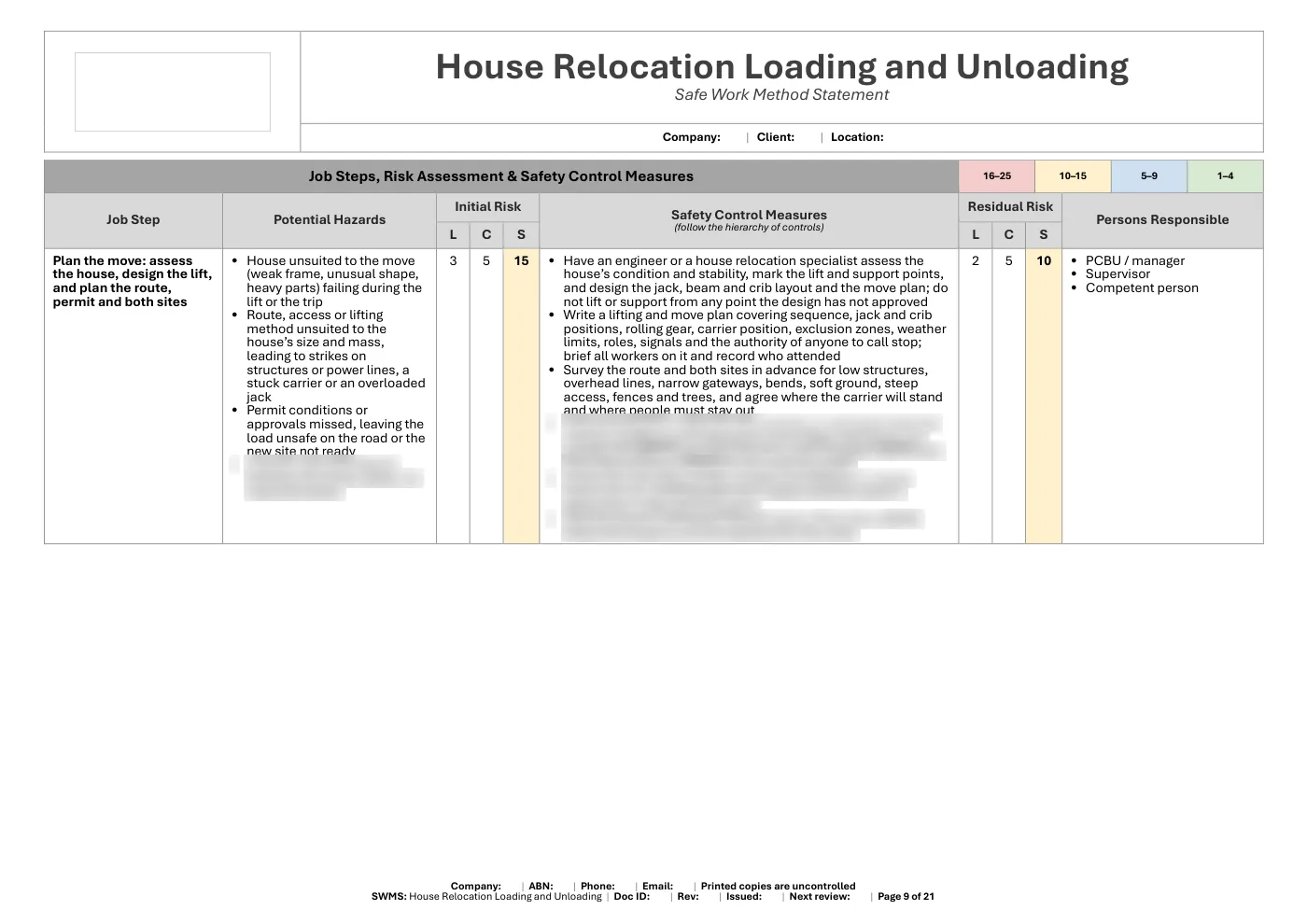
After the standard pre-start checks, the job steps run from “Plan the move: assess the house, design the lift, and plan the route, permit and both sites” to “Release the carrier, recover equipment and make both sites safe”. The hazards and controls include:
- House slipping off jacks, cribs and beams
- Crush injuries when lowering onto supports
- Stored energy released from jacks and winch lines
- House moving on rolling gear or the carrier
- Contact with overhead power lines
- Underground services struck near old footings
- Asbestos disturbed in an older house
- Services not safely disconnected
- Oversize load strikes on the road
- Load shifting on the carrier
- Carrier bogging or tipping on soft ground
- Falls from the house and the carrier
- Public and neighbours in the work area
High Risk Construction Work
These high risk construction work items (WHS Regulation 2011 (Qld) s 291) are already ticked because they are part of this work. Tick any others that apply to your job:
- Involves structural alterations or repairs that require temporary support to prevent collapse
- Is carried out in an area at a workplace in which there is any movement of powered mobile plant
Licences, Training and Competency
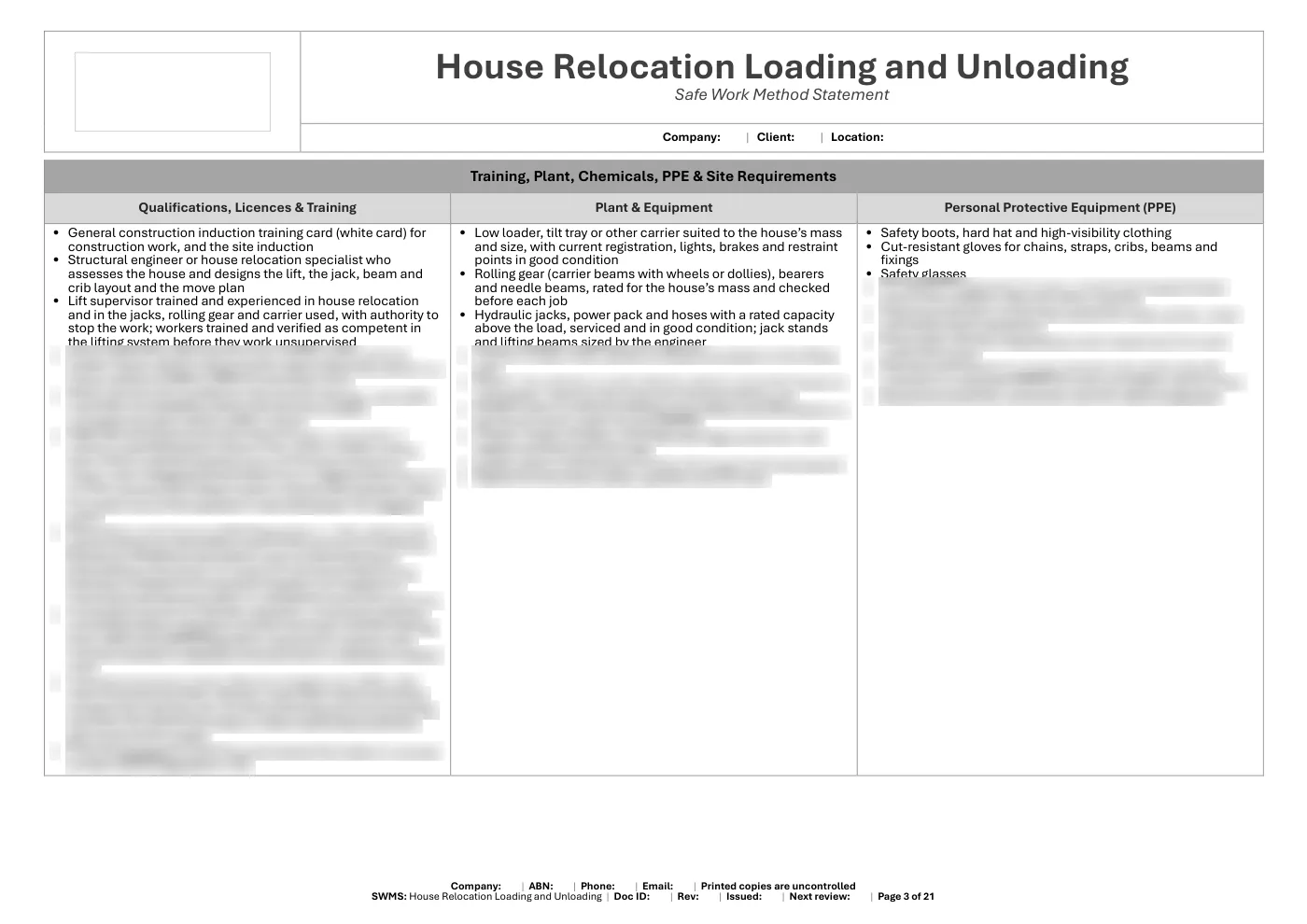
- General construction induction training card (white card) for construction work, and the site induction
- Structural engineer or house relocation specialist who assesses the house and designs the lift, the jack, beam and crib layout and the move plan
- Lift supervisor trained and experienced in house relocation and in the jacks, rolling gear and carrier used, with authority to stop the work; workers trained and verified as competent in the lifting system before they work unsupervised
- Driver licence for the class of truck, prime mover and low loader; heavy vehicle requirements apply where the carrier is a heavy vehicle (a GVM or ATM of more than 4.5 t)
- Pilots and escorts qualified as the permit requires, and traffic controller accreditation where the permit or traffic management plan call for traffic control
- High risk work licence for the class of crane used when a crane is used (Schedule 3 items 14 to 18 for mobile cranes; item 13 for a vehicle loading crane of 10 metre tonnes or more), and a dogging licence (item 4) or a rigging class (items 5 to 7) for anyone who slings a load or directs the operator when the load is out of the operator’s view (Schedule 19, dogging work)
- Demolition work licence (WHS Regulation s 143), held by the person doing any demolition work or the person it is done for; Schedule 19 defines demolition work as demolishing or dismantling a structure, or a part of a structure that is load-bearing or related to its physical integrity, so it applies to removing load-bearing walls or cutting the house into sections
- Competent person to identify asbestos, a licensed asbestos removalist where asbestos must be removed, and the training that s 445 of the WHS Regulation requires for workers who may be involved in asbestos removal work or asbestos-related work
- Licensed electrical worker (Electrical Safety Act 2002 s 55), and a licensed plumber, drainer or gas fitter where plumbing and gas law requires one, for disconnecting and reconnecting services; the electricity entity or other authorised authority disconnects the supply
- First aid equipment, facilities and trained first aiders or access to them (WHS Regulation s 42)
Legislation and Codes of Practice Referenced
- Work Health and Safety Act 2011 (Qld)
- Work Health and Safety Regulation 2011 (Qld)
- WHS Regulation 2011 (Qld) ss 289, 291 and 299: construction work, high risk construction work and the SWMS requirement; ss 142 and 143 and Schedule 19: written notice for the demolition work s 142 lists, the demolition work licence, and the meaning of demolition work
- WHS Regulation 2011 (Qld) ss 206, 210, 213, 214, 215 and 219: proper use of plant, operational controls, maintenance and inspection, powered mobile plant, and plant that lifts or suspends loads
- WHS Regulation 2011 (Qld) ss 304, 306C, 306D, 306M, 422, 445 and 458: underground essential services information, falls and ladders in construction work, and asbestos
- WHS Regulation 2011 (Qld) ss 40, 42, 48 and 60 (facilities and heat, first aid, remote or isolated work, hazardous manual tasks) and WHS Act 2011 (Qld) ss 35 to 39 (notifiable incidents)
- Heavy Vehicle National Law (Queensland), applied by the Heavy Vehicle National Law Act 2012 (Qld): s 6 (heavy vehicle means a vehicle with a GVM or ATM of more than 4.5 t), s 26C (primary duty of each party in the chain of responsibility), s 96 (compliance with mass requirements), s 110 (national regulations may prescribe loading requirements), s 111 (compliance with the loading requirements) and s 228 (duty of driver to avoid driving while fatigued or unfit to drive)
- Heavy Vehicle National Law (Queensland) Part 4.5: exemptions for particular overmass or oversize vehicles (the permit or notice and its conditions are outside this SWMS)
- National Load Restraint Guide (National Heavy Vehicle Regulator): guidance, not law
- Electrical Safety Act 2002 (Qld) s 55 (licensed electrical work) and Electrical Safety Regulation 2026 (Qld) sections 10 to 13 and schedule 2 (overhead line exclusion zones)
- Electrical Safety Code of Practice 2020 – Working near overhead and underground electric lines (distances come from the 2026 Regulation)
- Safe Design of Structures Code of Practice 2021 (modification of a structure)
- Demolition Work Code of Practice 2021
- Managing Risks of Plant in the Workplace Code of Practice 2021 (isolating energy sources, including stored energy)
- Managing the Risk of Falls at Workplaces Code of Practice 2021
- Hazardous Manual Tasks Code of Practice 2021
- Excavation Work Code of Practice 2021 (holes left by stumps and footings)
- Confined Spaces Code of Practice 2021 (when a subfloor meets the definition)
- How to Manage and Control Asbestos in the Workplace Code of Practice 2021
- Mobile Crane Code of Practice 2024 (where a mobile crane is used)
- Traffic Management for Construction or Maintenance Work Code of Practice 2008
- Managing the Work Environment and Facilities Code of Practice 2021
- First Aid in the Workplace Code of Practice 2021
- WorkSafe Queensland guide: Working safely in the house relocation industry (guidance, not law)
What You Get
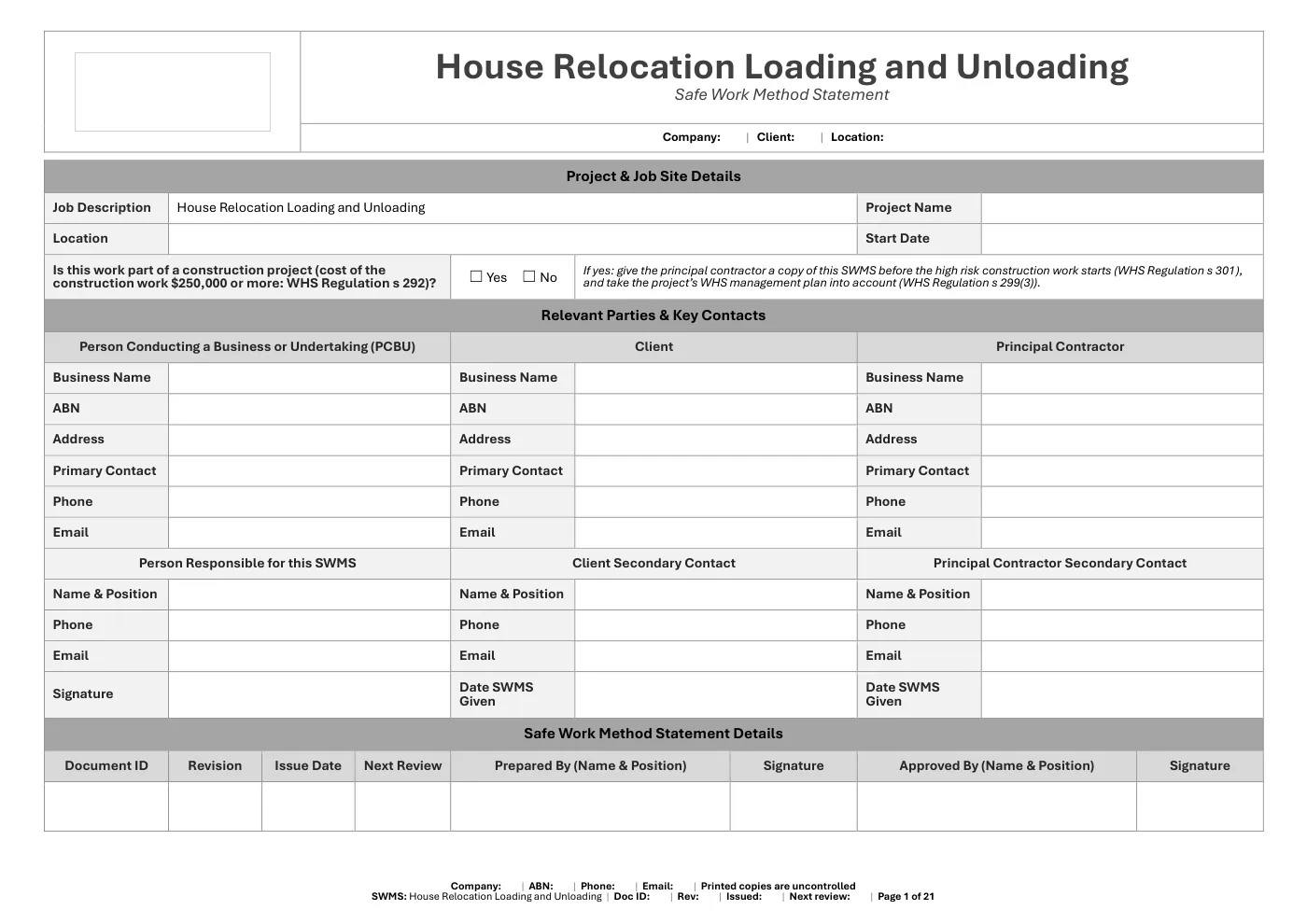
- An editable Microsoft Word document (21 A4 landscape pages). Type your business, client and job details once and they fill in on every page, with a space for your logo
- 11 job steps for this work, each with its hazards, controls, initial and residual risk scores and the person responsible
- PPE listed for this job: safety boots, hard hat and high-visibility clothing; cut-resistant gloves for chains, straps, cribs, beams and fixings; safety glasses
- Emergency arrangements for: person trapped under or crushed by the house, a jack or the load, contact with a power line and crash, breakdown or load shift on the road
- Plus the parts every Work Safety QLD SWMS shares, from the s 291 checklist to the worker sign-on sheet (see the layout in our free SWMS template)
Adjust it for your site, plant and crew, and talk it through with your workers before work starts. Please make sure you read our Disclaimer before downloading this SWMS.
Checked against the Queensland laws and codes of practice listed above. Last reviewed November 2026.

Reviews