Forklift and Telehandler Work Box SWMS
Lifting people in a personnel box on a forklift, or a maker-approved platform on a telehandler, in Queensland: attachment, load charts, communications and rescue. An editable Word SWMS template.
RG
Written by Ryan Graham, health and safety professional (16 years on Queensland sites)
$39.99 incl. GST
AUD · one-off purchase · instant download
- Instant download · your links arrive by email straight after checkout and work for 3 months, so save your copy
- Make it yours in minutes · edit in Microsoft Word and add your logo
- Quality guarantee · we'll fix any problem, then refund you or give store credit if you're still not happy
- Secure checkout · card, Apple Pay or Google Pay through Stripe
Save with a bundle
About this template
For businesses that sometimes lift workers in a personnel box (a cage, often called a work box) on a forklift, or in a maker-approved platform on a telehandler, because no elevating work platform or scaffold is reasonably practicable. It follows the job from deciding that lifting people is justified through checking the machine, box and licences, securing the box, loading, lifting and working to lowering, rescue from a failure and storage. General forklift and telehandler operation have their own SWMS.
Lifting people with a forklift or telehandler is not construction work by itself, and a SWMS is legally required only for high risk construction work (WHS Regulation s 299), so no item is pre-ticked. If the work is construction work, tick movement of powered mobile plant (item o), a fall of more than 2 metres (item a) when the work position is more than 2 metres above the ground, energised electrical installations or services (item k) when lines or services are near, and any other item that applies; otherwise this works as a written safe work procedure or task risk assessment. WHS Regulation s 220 sets conditions for lifting people in a work box, which Schedule 19 defines as a device designed to be suspended from a crane, and s 218(2) limits passengers on an industrial lift truck: ask WorkSafe Queensland how they apply to a box on forks, and confirm the maker’s or engineer’s approval of the box and its attachment before anyone is lifted. This template does not replace the maker’s instructions or that advice.
New to SWMS? Read What Is A Safe Work Method Statement?
What Is Covered In Our Forklift and Telehandler Work Box SWMS?
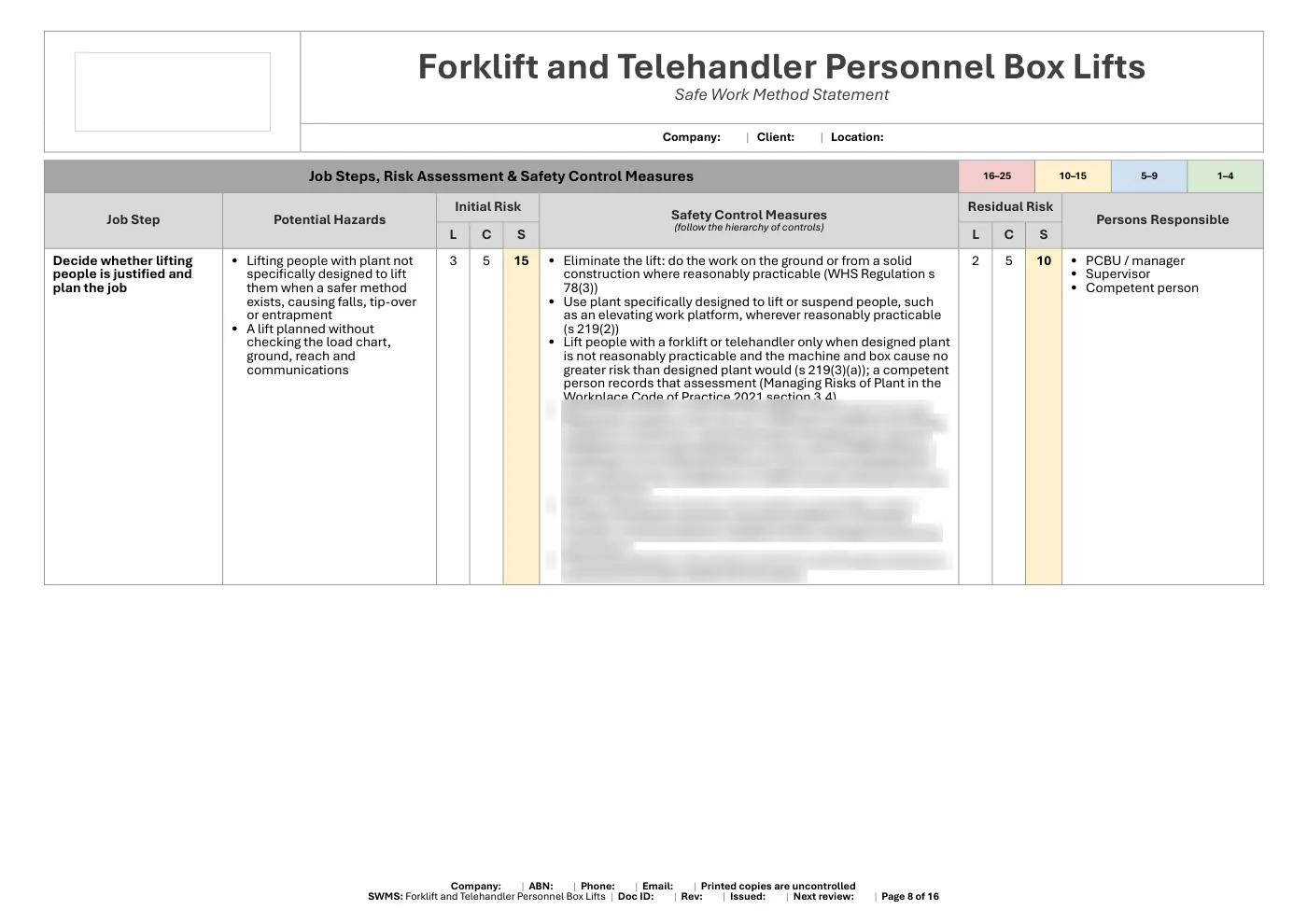
After the standard pre-start checks, the job steps run from “Decide whether lifting people is justified and plan the job” to “Park, remove the personnel box and store”. The hazards and controls include:
- Personnel box detaching from the forks or carriage
- Machine tip-over with people in the box
- Overloading beyond the box or load chart
- Falls from the box at height
- Contact with overhead power lines
- Tools and objects falling on people below
- Machine or power failure with people stranded
- Suspension trauma in a harness
- Crushing at the carriage and forks
- Operator losing sight of the box
- Weather and wind at the work position
- Unlicensed or untrained operators
High Risk Construction Work
None of the high risk construction work items (WHS Regulation 2011 (Qld) s 291) are pre-ticked, because this job is not high risk construction work by itself. Tick any that apply on your site.
Licences, Training and Competency
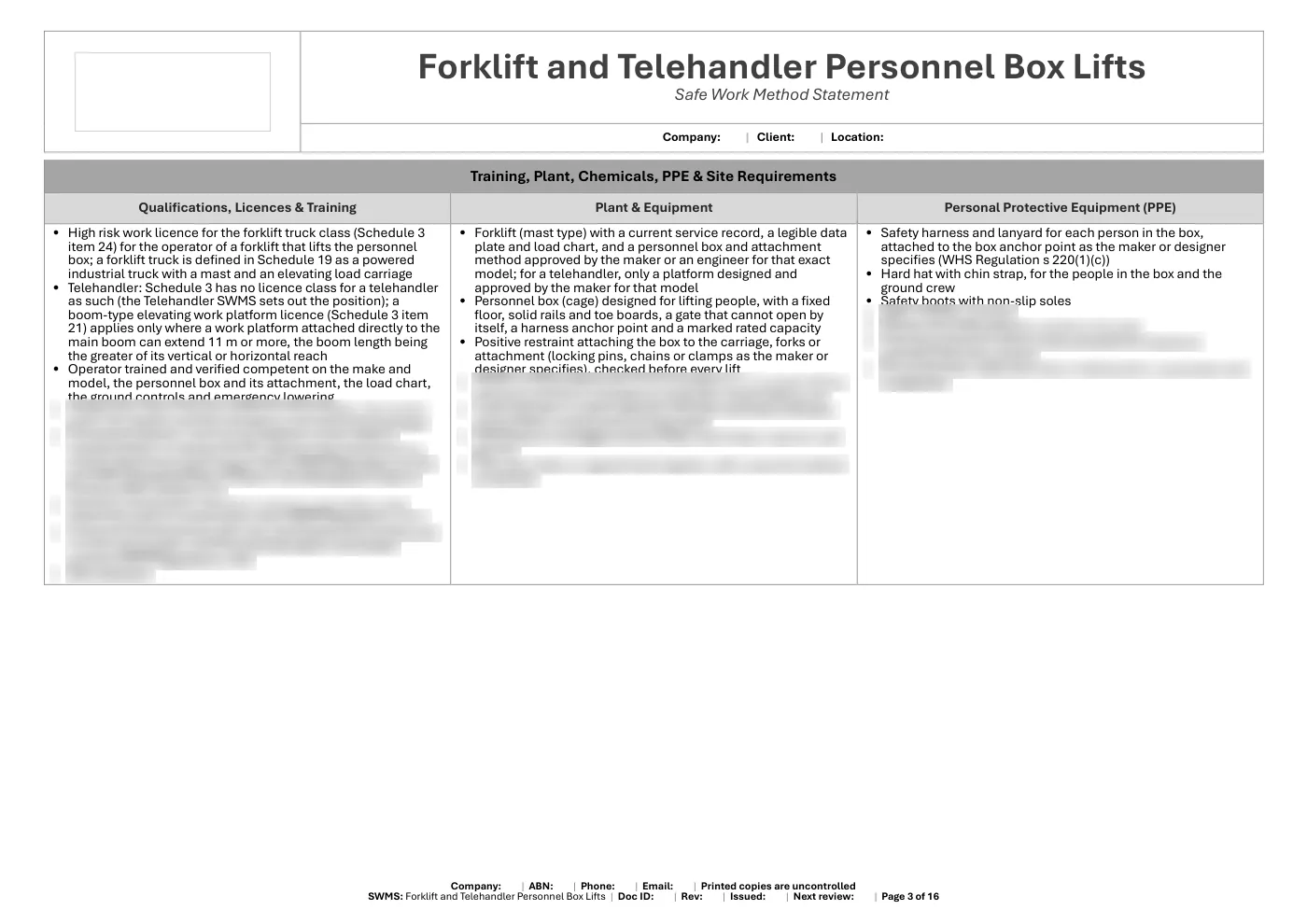
- High risk work licence for the forklift truck class (Schedule 3 item 24) for the operator of a forklift that lifts the personnel box; a forklift truck is defined in Schedule 19 as a powered industrial truck with a mast and an elevating load carriage
- Telehandler: Schedule 3 has no licence class for a telehandler as such (the Telehandler SWMS sets out the position); a boom-type elevating work platform licence (Schedule 3 item 21) applies only where a work platform attached directly to the main boom can extend 11 m or more, the boom length being the greater of its vertical or horizontal reach
- Operator trained and verified competent on the make and model, the personnel box and its attachment, the load chart, the ground controls and emergency lowering
- People who ride in the box trained in the harness, the anchor point, the signals and the emergency exit and lowering steps
- Competent person, such as an engineer or the maker’s representative, to assess the lift, approve the personnel box and its attachment and inspect them (WHS Regulation ss 219 and 220; Managing Risks of Plant in the Workplace Code of Practice 2021 section 3.4)
- General construction induction training card (white card) where the work is construction work (WHS Regulation s 317)
- A second trained person who can use the ground controls and run the rescue plan, and first aid training for nominated workers (WHS Regulation s 42)
- Site induction
Legislation and Codes of Practice Referenced
- Work Health and Safety Act 2011 (Qld)
- Work Health and Safety Regulation 2011 (Qld)
- Work Health and Safety Regulation 2011 (Qld): ss 218 to 220 (industrial lift trucks; plant that lifts or suspends loads; plant not specifically designed to lift or suspend a person)
- Work Health and Safety Regulation 2011 (Qld): ss 78 to 80 (risk of a fall, specific measures to minimise it, emergency and rescue procedures)
- Work Health and Safety Regulation 2011 (Qld): ss 54 and 55 (falling objects)
- Work Health and Safety Regulation 2011 (Qld): ss 214 and 215 (powered mobile plant)
- Work Health and Safety Regulation 2011 (Qld): ss 306C, 306D and 315B to 315M (falls and falling objects, where the work is construction work)
- Work Health and Safety Regulation 2011 (Qld): Schedule 3 (forklift truck and boom-type elevating work platform licence classes) and Schedule 19 (definitions of forklift truck and work box; a work box is defined as a personnel carrying device designed to be suspended from a crane)
- Managing Risks of Plant in the Workplace Code of Practice 2021 (section 3.3, using plant in the workplace, including lifting people; section 3.4, making changes)
- Rural Plant Code of Practice 2024 (section 7.9, plant that lifts or moves persons, equipment or material)
- Managing the Risk of Falls at Workplaces Code of Practice 2021
- Hazardous Manual Tasks Code of Practice 2021
- First Aid in the Workplace Code of Practice 2021
- How to Manage Work Health and Safety Risks Code of Practice 2021
- AS 2359.1 Powered industrial trucks – Part 1: General requirements (named in the Rural Plant Code of Practice 2024)
- Electrical Safety Act 2002 (Qld): s 55 (electrical work needs a licensed electrical worker)
- Electrical Safety Regulation 2026 (Qld): overhead power line exclusion zones in sections 10 to 13 and schedule 2
- Electrical Safety Code of Practice 2020 – Working near overhead and underground electric lines
- Safe Work Australia model Code of Practice: Elevating work platforms (model code, not approved in Queensland; guidance only), section 5.7 on telehandlers used as an EWP
What You Get
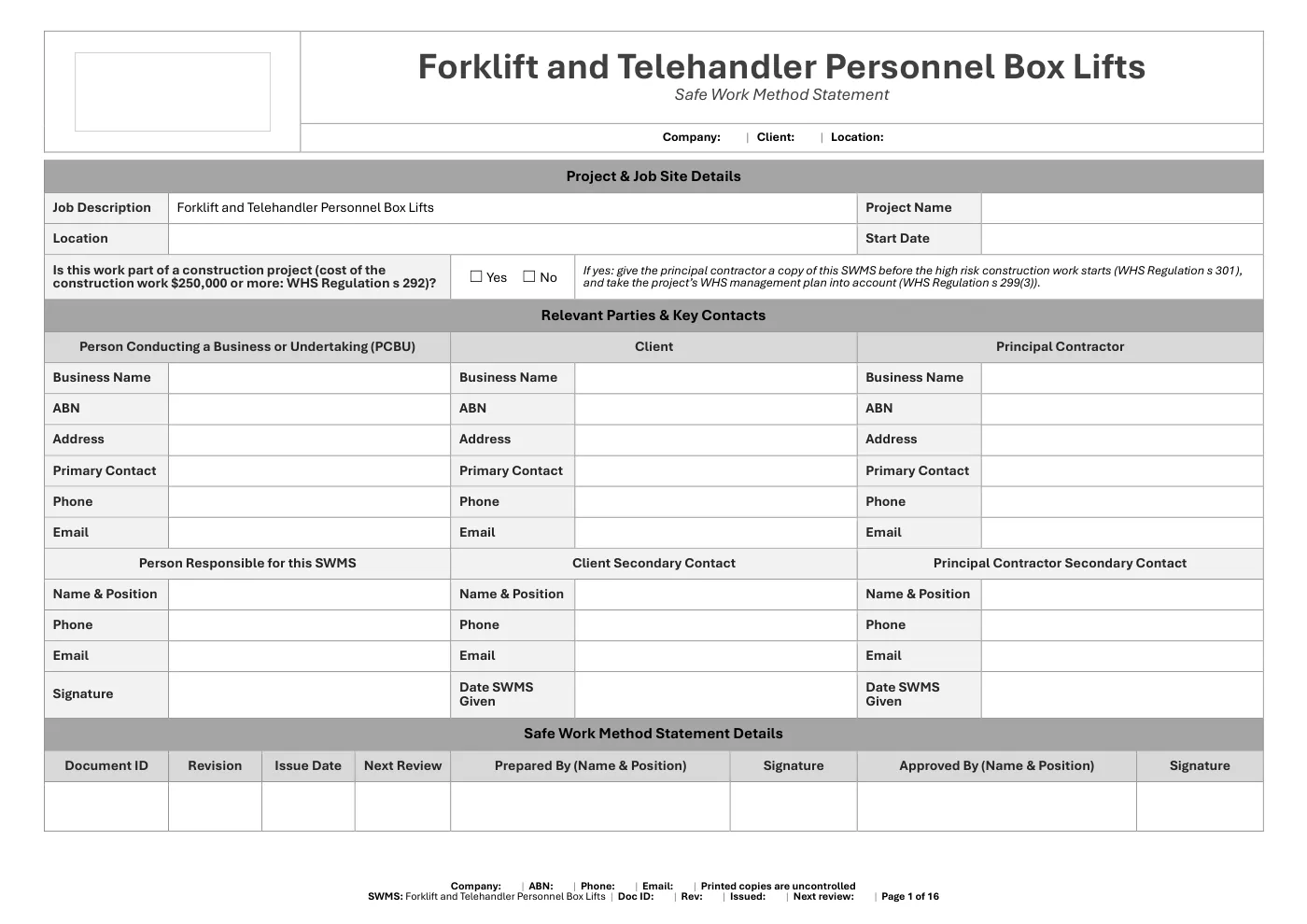
- An editable Microsoft Word document (16 A4 landscape pages). Type your business, client and job details once and they fill in on every page, with a space for your logo
- 11 job steps for this work, each with its hazards, controls, initial and residual risk scores and the person responsible
- PPE listed for this job: safety harness and lanyard for each person in the box, attached to the box anchor point as the maker or designer specifies (WHS Regulation s 220(1)(c))
- Emergency arrangements for: machine or power failure with people in the box, tip-over with people in the box and contact with an overhead power line
- Plus the parts every Work Safety QLD SWMS shares, from the s 291 checklist to the worker sign-on sheet (see the layout in our free SWMS template)
Adjust it for your site, plant and crew, and talk it through with your workers before work starts. Please make sure you read our Disclaimer before downloading this SWMS.
Checked against the Queensland laws and codes of practice listed above. Last reviewed November 2026.
Having trouble with your download? Contact us any time. Please read our Disclaimer before downloading.
How to use it
From download to site in three steps
Buy and download
Check out with card, Apple Pay or Google Pay. Your download buttons appear straight away and the links are emailed to you. Links work for 3 months, so save your copies.
Make it yours
Open it in Microsoft Word or Excel. Add your logo, business details, site and job information, and adjust it to how the work is done.
Brief your crew
Talk it through with the workers doing the job, have them sign on, and keep it on site. Review it whenever the job or conditions change.
What format is it?
Microsoft Word. Edit it in Word, or free in Word for the web, and add your own logo and business details.
How do I get it after I pay?
Your download buttons appear as soon as checkout finishes, and the links are emailed to you. You can re-download from your account at any time.
Is it compliant with Queensland law?
It's written around Queensland's Work Health and Safety Act 2011 and Regulation 2011. Tailor it to your site, consult your workers and review it whenever conditions change; no template can guarantee compliance on its own.
What if it isn't right for my job?
If it doesn't match its description or has a fault, tell us and we'll fix it. If you're still not happy, we'll refund you or give you store credit, your choice. Check the sample pages first, as we don't refund a change of mind.
More templates like this
$49.99
Manual Handling SWMS
$49.99
Hot Work SWMS
$39.99


Reviews