Cotton Picker and Module Builder Operation SWMS
Cotton pickers and module builders at harvest in Queensland: entanglement, fire, roll-over, blockage clearing and overhead power lines. An editable Word SWMS template.
RG
Written by Ryan Graham, health and safety professional (16 years on Queensland sites)
$39.99 incl. GST
AUD · one-off purchase · instant download
- Instant download · your links arrive by email straight after checkout and work for 3 months, so save your copy
- Make it yours in minutes · edit in Microsoft Word and add your logo
- Quality guarantee · we'll fix any problem, then refund you or give store credit if you're still not happy
- Secure checkout · card, Apple Pay or Google Pay through Stripe
Save with a bundle
About this template
Suits cotton growers and harvesting contractors who run cotton pickers and module builders at harvest. It covers the pre-start check, field and module site planning, picking in the row, slopes and channel edges, unloading to the module builder, overhead power lines, clearing blockages under isolation, fire control, long and night shifts, and road travel. Servicing, repairs and module transport use separate SWMS.
Cotton picking is not high risk construction work, so no item is pre-ticked and a SWMS is required by law only for high risk construction work (WHS Regulation s 299); this document works as a written safe work procedure or task risk assessment that you tailor to your farm or contract. If any of the work is part of construction work, tick the reg 291 items that apply, for example movement of powered mobile plant.
New to SWMS? Read What Is A Safe Work Method Statement?
What Is Covered In Our Cotton Picker and Module Builder Operation SWMS?
After the standard pre-start checks, the job steps run from “Pre-start picker and module builder check” to “Road travel, park and shut down”. The hazards and controls include:
- Entanglement in picking heads, drums and doffers
- Debris thrown from the heads and fans
- Missing or damaged guards
- Machine fire from lint and trash on hot parts
- Roll-over on slopes, channel edges and soft ground
- Crush or entrapment in the module builder
- Collision with boll buggies, module trucks and people
- Raised baskets contacting overhead power lines
- Clearing blockages on a running machine
- Falls from the cab, steps and module builder
- Fatigue on long and night shifts
- Heat, dust and noise in the cab
High Risk Construction Work
None of the high risk construction work items (WHS Regulation 2011 (Qld) s 291) are pre-ticked, because this job is not high risk construction work by itself. Tick any that apply on your site.
Licences, Training and Competency
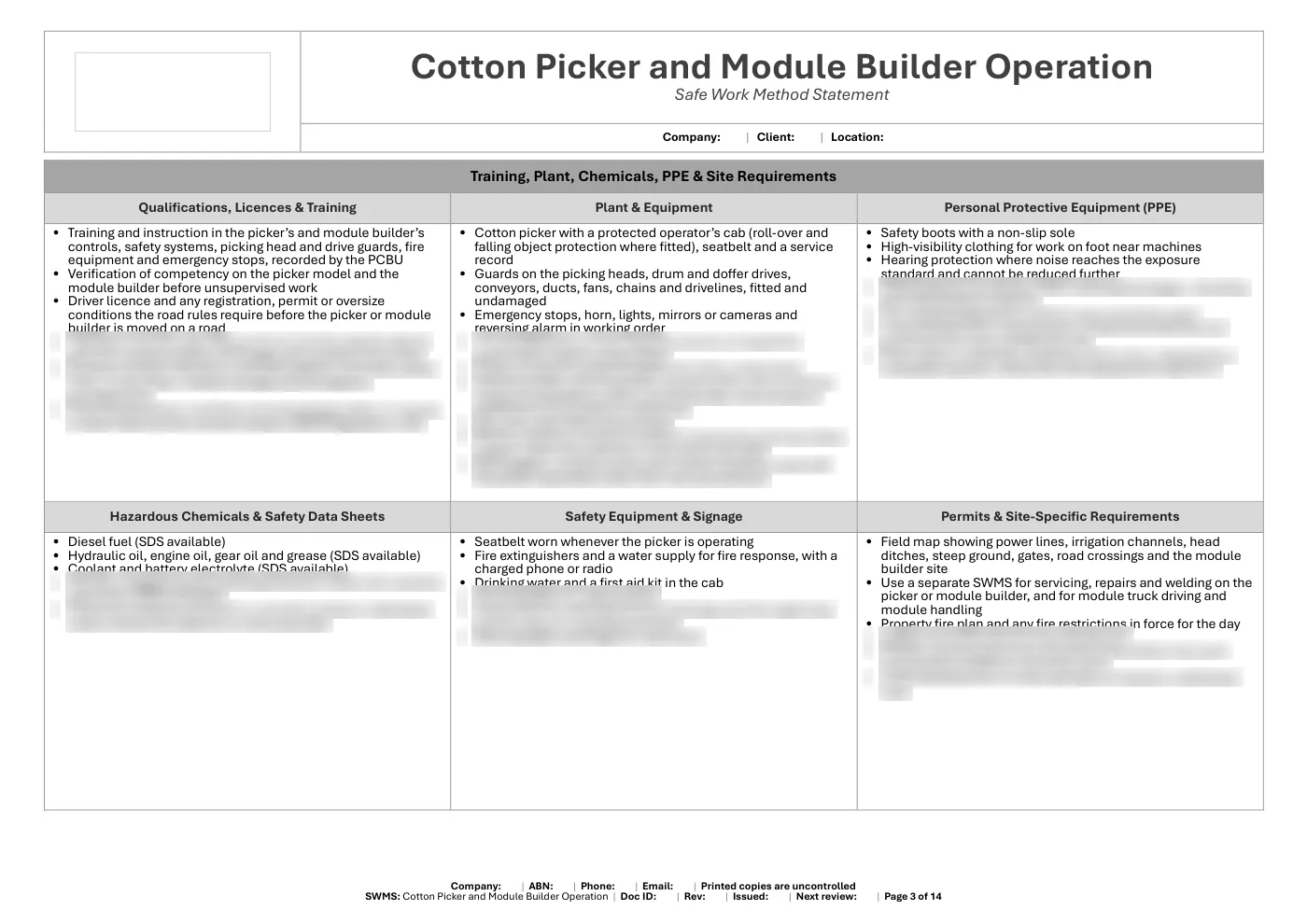
- Training and instruction in the picker’s and module builder’s controls, safety systems, picking head and drive guards, fire equipment and emergency stops, recorded by the PCBU
- Verification of competency on the picker model and the module builder before unsupervised work
- Driver licence and any registration, permit or oversize conditions the road rules require before the picker or module builder is moved on a road
- Training in the two-way radio protocol and the signals agreed with the module builder, boll buggy and module truck crews
- Property and gin induction covering irrigation channels, power lines, no-go areas, module storage and emergency arrangements
- First aid equipment, facilities and trained first aiders or access to them that suit the remote location (WHS Regulation s 42)
Legislation and Codes of Practice Referenced
- Work Health and Safety Act 2011 (Qld)
- Work Health and Safety Regulation 2011 (Qld)
- WHS Regulation 2011 (Qld) ss 208, 210, 213, 214 and 215: guarding, operational controls, maintenance and inspection of plant, powered mobile plant and operator protective devices
- WHS Regulation 2011 (Qld) s 216: roll-over protection applies to a tractor, which Schedule 19 defines as a vehicle designed to provide power and movement to an attached machine or implement, so it applies to any tractor used to tow or drive the module builder; a self-propelled cotton picker carries its own picking heads, so ss 214 and 215 and the Rural Plant Code of Practice 2024 section 7.3 are relied on for it
- WHS Regulation 2011 (Qld) ss 48, 52 and 53: remote or isolated work, ignition sources in a hazardous atmosphere and flammable stock
- WHS Regulation 2011 (Qld) ss 56 and 57: noise exposure standard and managing the risk of hearing loss
- Rural Plant Code of Practice 2024
- Managing Risks of Plant in the Workplace Code of Practice 2021
- Hazardous Manual Tasks Code of Practice 2021
- Managing Noise and Preventing Hearing Loss at Work Code of Practice 2021
- Managing Risks of Hazardous Chemicals in the Workplace Code of Practice 2021
- First Aid in the Workplace Code of Practice 2021
- How to Manage Work Health and Safety Risks Code of Practice 2021
- Electrical Safety Act 2002 (Qld)
- Electrical Safety Regulation 2026 (Qld): overhead power line exclusion zones in sections 10 to 13 and schedule 2
- Electrical Safety Code of Practice 2020 – Working near overhead and underground electric lines
- Safe Work Australia model Code of Practice: Managing the risk of fatigue at work (model code, not approved in Queensland; guidance only)
What You Get
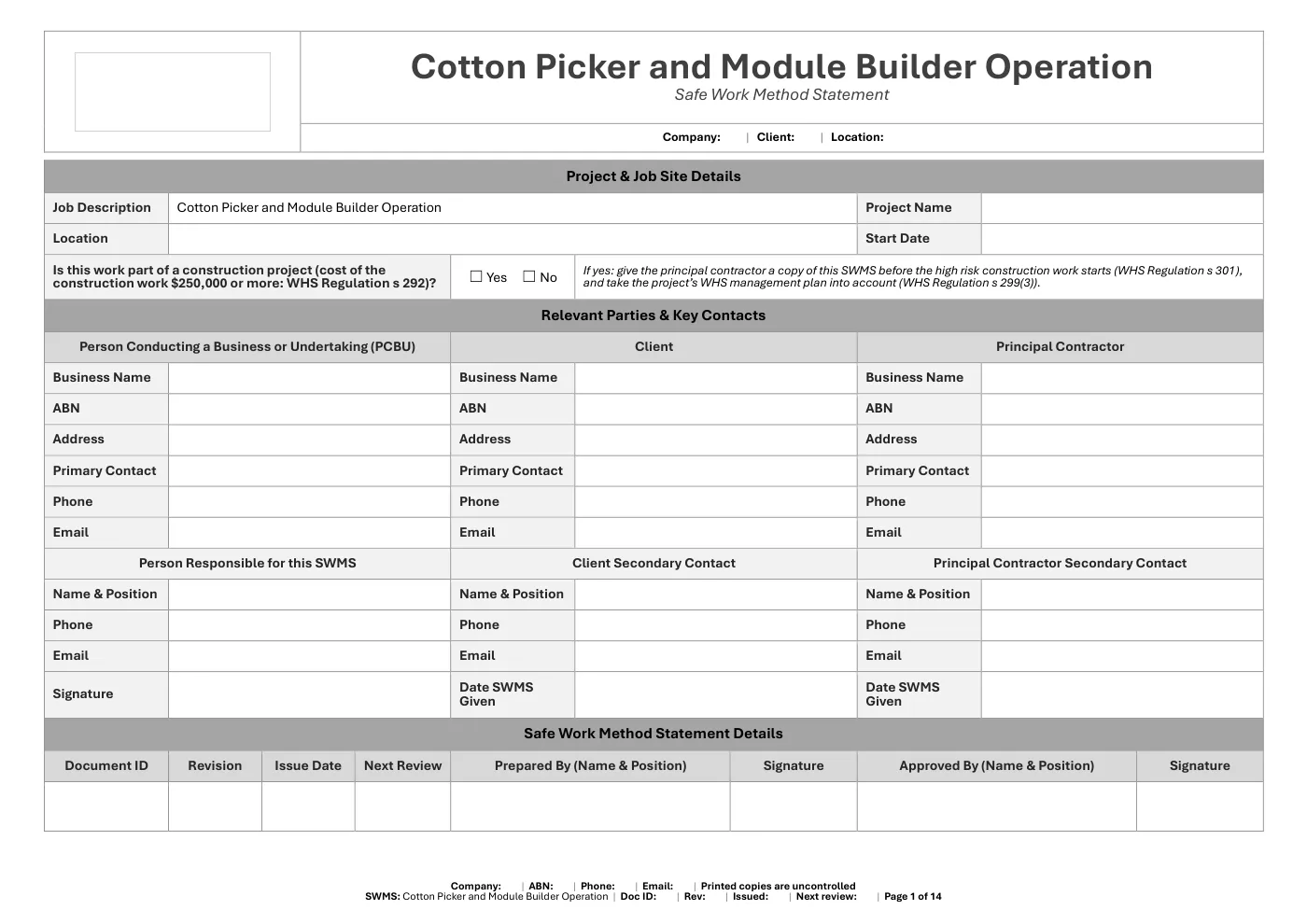
- An editable Microsoft Word document (14 A4 landscape pages). Type your business, client and job details once and they fill in on every page, with a space for your logo
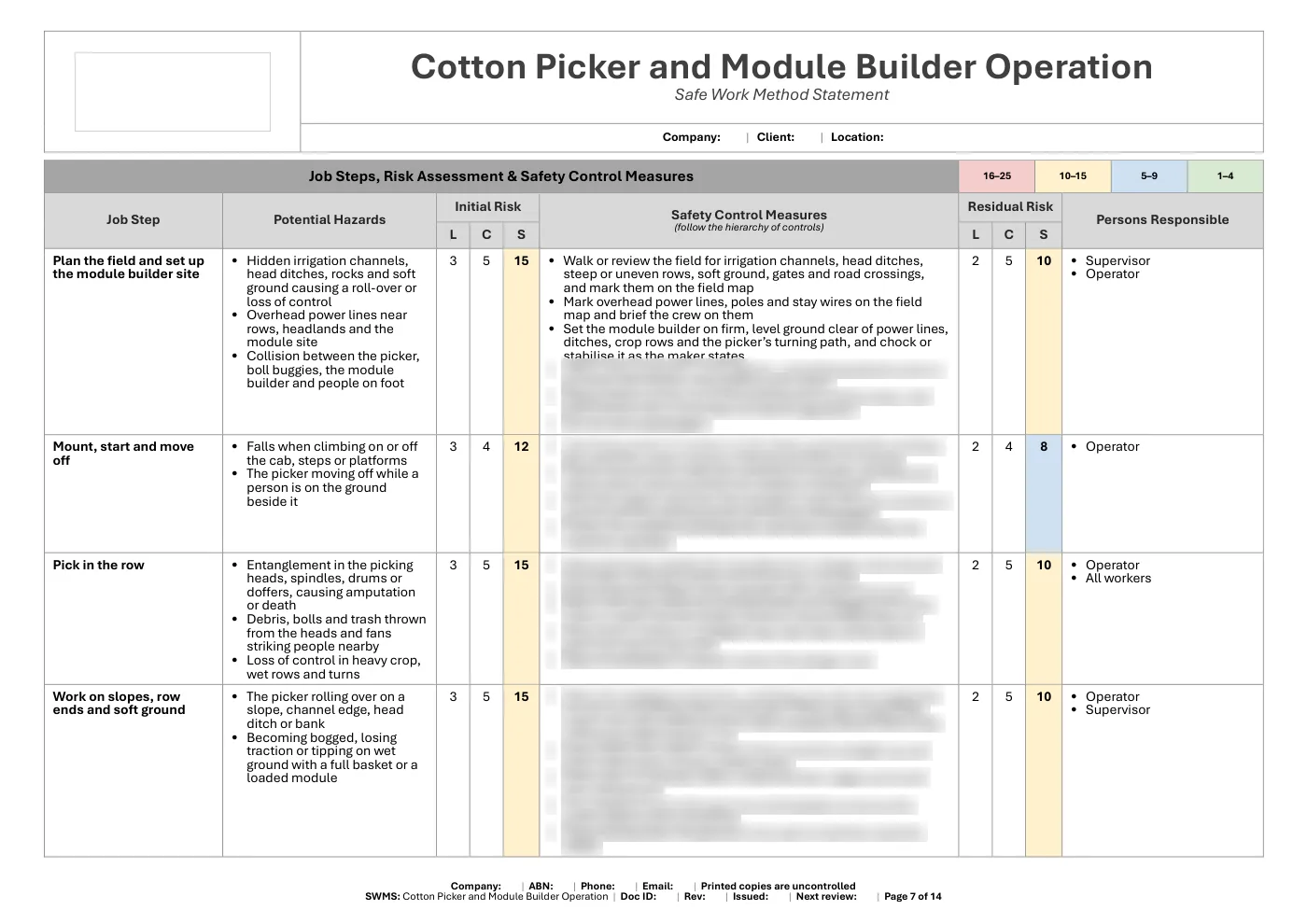
- 11 job steps for this work, each with its hazards, controls, initial and residual risk scores and the person responsible
- PPE listed for this job: safety boots with a non-slip sole; high-visibility clothing for work on foot near machines; hearing protection where noise reaches the exposure standard and cannot be reduced further
- Emergency arrangements for: machine fire, roll-over and power line contact (general guidance)
- Plus the parts every Work Safety QLD SWMS shares, from the s 291 checklist to the worker sign-on sheet (see the layout in our free SWMS template)
Adjust it for your site, plant and crew, and talk it through with your workers before work starts. Please make sure you read our Disclaimer before downloading this SWMS.
Checked against the Queensland laws and codes of practice listed above. Last reviewed November 2026.
Having trouble with your download? Contact us any time. Please read our Disclaimer before downloading.
How to use it
From download to site in three steps
Buy and download
Check out with card, Apple Pay or Google Pay. Your download buttons appear straight away and the links are emailed to you. Links work for 3 months, so save your copies.
Make it yours
Open it in Microsoft Word or Excel. Add your logo, business details, site and job information, and adjust it to how the work is done.
Brief your crew
Talk it through with the workers doing the job, have them sign on, and keep it on site. Review it whenever the job or conditions change.
What format is it?
Microsoft Word. Edit it in Word, or free in Word for the web, and add your own logo and business details.
How do I get it after I pay?
Your download buttons appear as soon as checkout finishes, and the links are emailed to you. You can re-download from your account at any time.
Is it compliant with Queensland law?
It's written around Queensland's Work Health and Safety Act 2011 and Regulation 2011. Tailor it to your site, consult your workers and review it whenever conditions change; no template can guarantee compliance on its own.
What if it isn't right for my job?
If it doesn't match its description or has a fault, tell us and we'll fix it. If you're still not happy, we'll refund you or give you store credit, your choice. Check the sample pages first, as we don't refund a change of mind.
More templates like this
$39.99

Excavator SWMS
$49.99


Reviews