Skip to content

Container Lashing and Twistlock Handling SWMS

Lashing and releasing shipping containers and twistlocks on trucks and wharves in Queensland: falls from containers, crush points, lashback and traffic. An editable Word SWMS template.

RG

Written by Ryan Graham, health and safety professional (16 years on Queensland sites)

$39.99 incl. GST

AUD · one-off purchase · instant download

  • Instant download · your links arrive by email straight after checkout and work for 3 months, so save your copy
  • Make it yours in minutes · edit in Microsoft Word and add your logo
  • Quality guarantee · we'll fix any problem, then refund you or give store credit if you're still not happy
  • Secure checkout · card, Apple Pay or Google Pay through Stripe

About this template

For stevedores, terminal and port operators, container depots, freight forwarders and transport companies whose lashers and drivers fit and release twistlocks and lashings. It follows the work from planning and gear inspection through moving around plant and traffic, releasing and locking twistlocks, lashing by hand, work at height and working near lifts, to the final truck check and stowing gear. Crane, reach stacker and forklift operation, container unpacking and prime mover coupling need their own SWMS.

Container lashing at a wharf, terminal or depot is not construction work by itself, so no item is pre-ticked and a SWMS is required by law only for high risk construction work (WHS Regulation s 299); this document works as a written safe work procedure or task risk assessment that you tailor to your site. If any of the work is part of construction work, tick the reg 291 items that apply, for example a risk of a fall of more than 2 m (item a), work in or adjacent to a road, railway, shipping lane or other traffic corridor in use (item n), movement of powered mobile plant (item o) or work in or near water with a risk of drowning (item q).

New to SWMS? Read What Is A Safe Work Method Statement?

What Is Covered In Our Container Lashing and Twistlock Handling SWMS?

After the standard pre-start checks, the job steps run from “Plan the work, brief the crew and agree signals” to “Stow the gear, tidy the area and report”. The hazards and controls include:

  • Falls from container tops and trailer decks
  • Crush between containers, chassis and cell guides
  • Struck by trucks, reach stackers and straddle carriers
  • Lashback from lashing bars and turnbuckles
  • Containers swinging or being landed on workers
  • Seized or damaged twistlocks
  • Containers not locked before the truck leaves
  • Falls from the wharf edge
  • Manual handling of heavy lashing gear
  • Misunderstood signals near lifts
  • Heat, wind, rain and night work
  • Noise and fatigue
  • Leaking or damaged containers and unexpected dangerous goods

High Risk Construction Work

None of the high risk construction work items (WHS Regulation 2011 (Qld) s 291) are pre-ticked, because this job is not high risk construction work by itself. Tick any that apply on your site.

Licences, Training and Competency

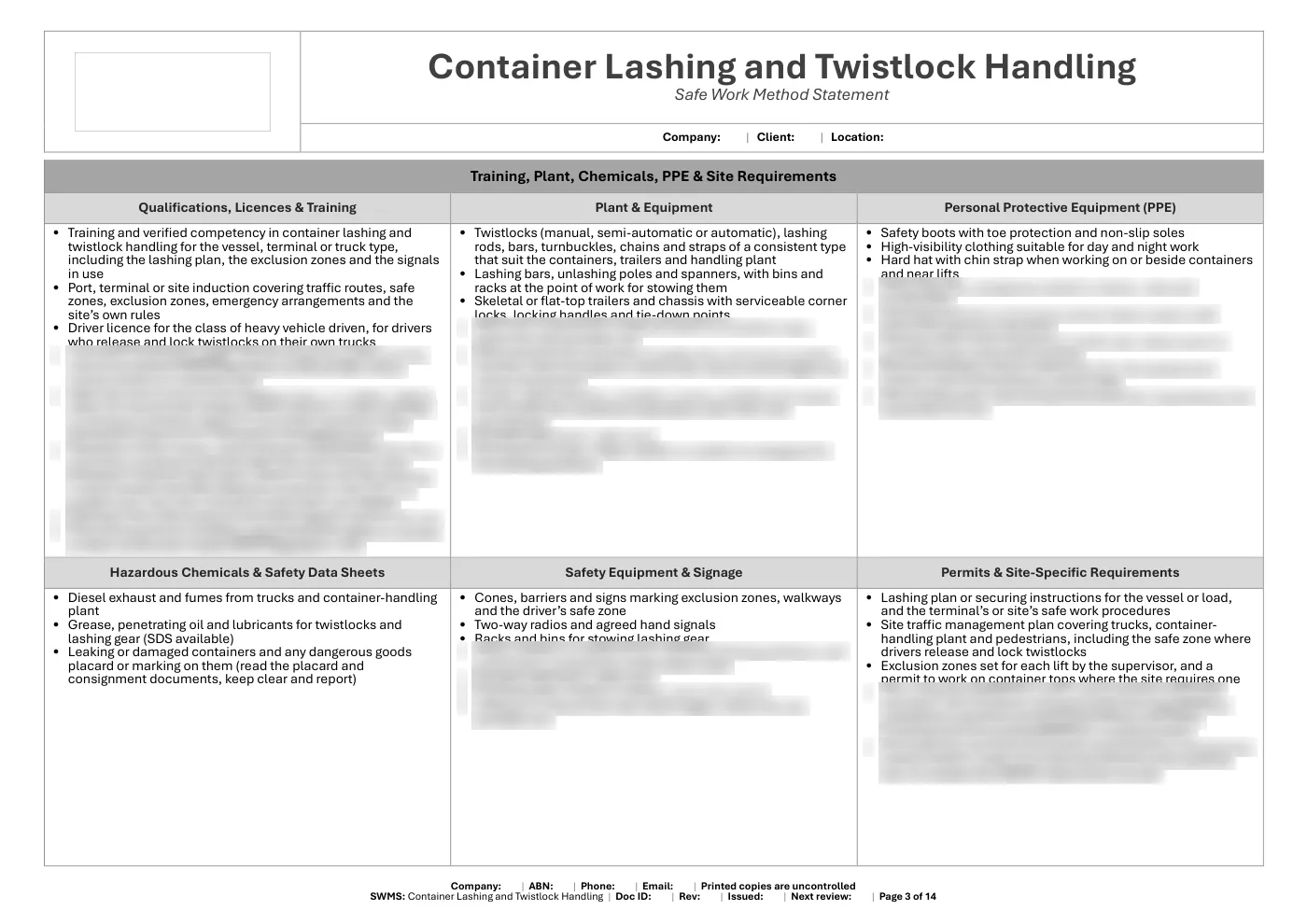
  • Training and verified competency in container lashing and twistlock handling for the vessel, terminal or truck type, including the lashing plan, the exclusion zones and the signals in use
  • Port, terminal or site induction covering traffic routes, safe zones, exclusion zones, emergency arrangements and the site’s own rules
  • Driver licence for the class of heavy vehicle driven, for drivers who release and lock twistlocks on their own trucks
  • Training in working at height, the fall protection used and the rescue procedure (WHS Regulation ss 39 and 80), where anyone works on container tops
  • High risk work licence in the dogging class, or a higher rigging class, for anyone who slings a load or directs a plant operator in moving a container when it is out of the operator’s view (Schedule 3 items 4 to 7; Schedule 19 dogging work)
  • Operators of the cranes, reach stackers and forklifts that lift or move the containers hold the high risk work licence class Schedule 3 sets for their plant, where it sets one (for example a reach stacker that lifts shipping containers, item 23, or a forklift truck, item 24), and work under their own SWMS
  • Training in the radio protocol and hand signals used on the site
  • First aid equipment, facilities and trained first aiders or access to them as the work needs (WHS Regulation s 42)

Legislation and Codes of Practice Referenced

  • Work Health and Safety Act 2011 (Qld)
  • Work Health and Safety Regulation 2011 (Qld)
  • WHS Regulation 2011 (Qld) ss 78 to 80: management of the risk of a fall, specific requirements to minimise the risk of a fall and emergency and rescue procedures for fall arrest systems
  • WHS Regulation 2011 (Qld) ss 54, 55 and 219: falling objects and plant that lifts or suspends loads
  • WHS Regulation 2011 (Qld) ss 214 and 215: powered mobile plant, including collisions with pedestrians and warning devices
  • WHS Regulation 2011 (Qld) ss 40, 41, 56, 57 and 60: workplace facilities, drinking water, noise and hazardous manual tasks
  • Managing Risks in Stevedoring Code of Practice 2023 (lashing and unlashing containers, suspended loads, traffic management, falls and weather; written for stevedoring operations and used as good practice at depots and yards)
  • Managing the Risk of Falls at Workplaces Code of Practice 2021
  • Managing Risks of Plant in the Workplace Code of Practice 2021
  • Hazardous Manual Tasks Code of Practice 2021
  • Managing Noise and Preventing Hearing Loss at Work Code of Practice 2021
  • Managing the Work Environment and Facilities Code of Practice 2021
  • First Aid in the Workplace Code of Practice 2021
  • How to Manage Work Health and Safety Risks Code of Practice 2021
  • Heavy Vehicle National Law (Queensland), applied by the Heavy Vehicle National Law Act 2012 (Qld): s 6 (heavy vehicle means a vehicle with a GVM or ATM of more than 4.5 t), s 26C (primary duty of each party in the chain of responsibility), s 96 (compliance with mass requirements), s 110 (national regulations may prescribe loading requirements), s 111 (compliance with the loading requirements) and s 228 (duty of driver to avoid driving while fatigued or unfit to drive)
  • National Load Restraint Guide (National Heavy Vehicle Regulator): guidance, not law
  • Safe Work Australia model Code of Practice: Managing the risk of fatigue at work (model code, not approved in Queensland; guidance only)

What You Get

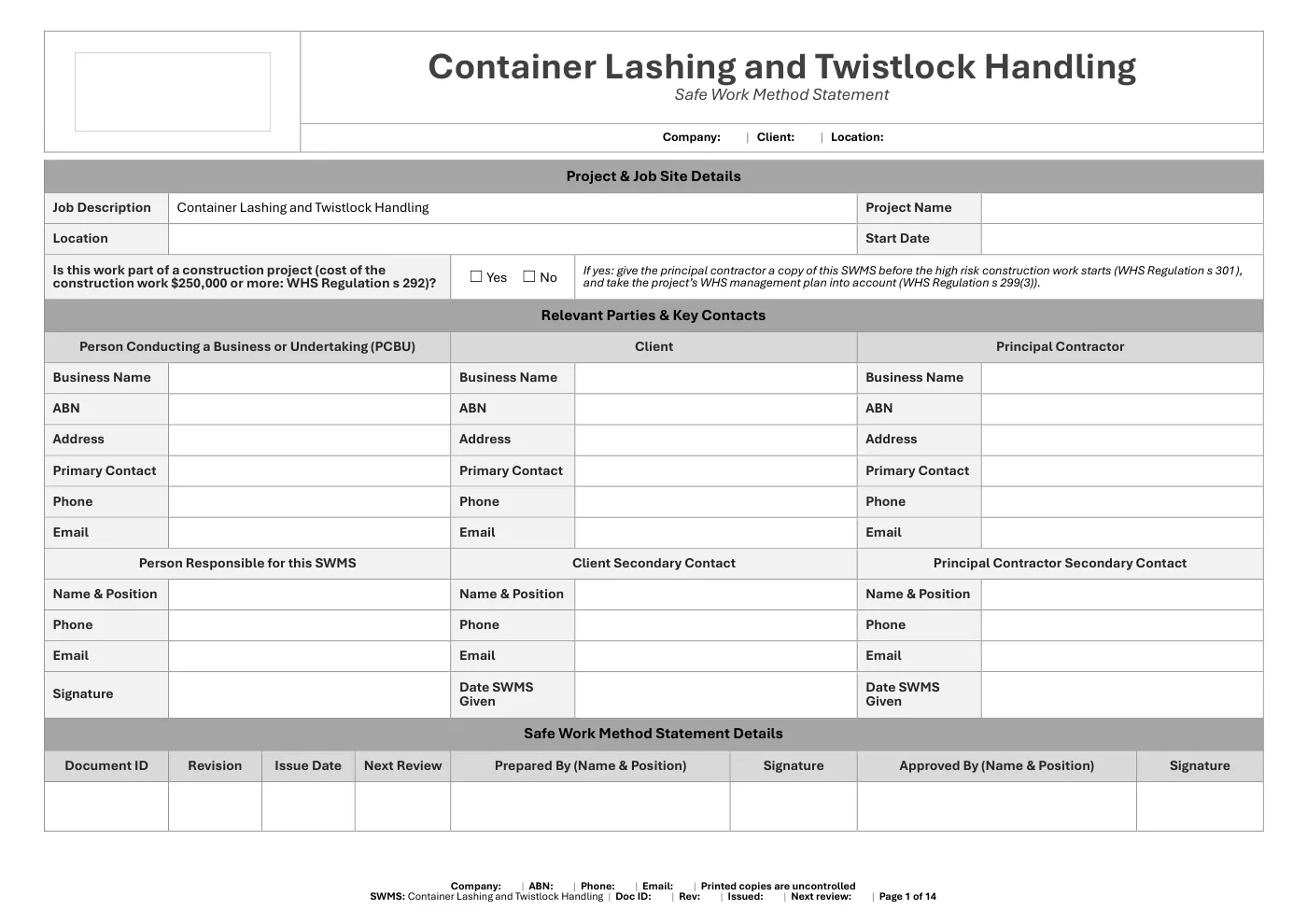
  • An editable Microsoft Word document (14 A4 landscape pages). Type your business, client and job details once and they fill in on every page, with a space for your logo
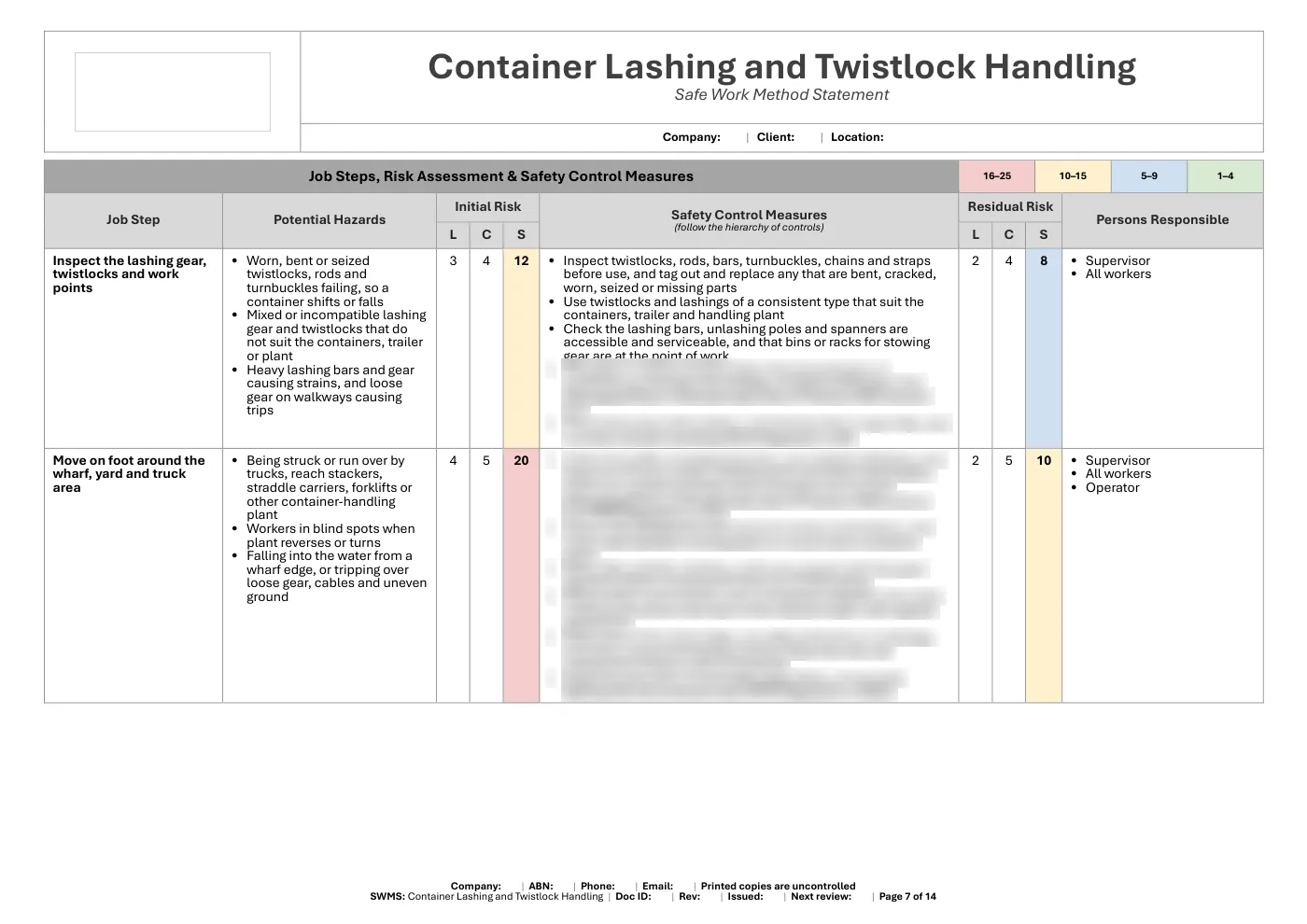
  • 10 job steps for this work, each with its hazards, controls, initial and residual risk scores and the person responsible
  • PPE listed for this job: safety boots with toe protection and non-slip soles; high-visibility clothing suitable for day and night work; hard hat with chin strap when working on or beside containers and near lifts
  • Emergency arrangements for: person struck or crushed by a container or plant, fall from a container or into the water and lashing rod, bar or twistlock released under load
  • Plus the parts every Work Safety QLD SWMS shares, from the s 291 checklist to the worker sign-on sheet (see the layout in our free SWMS template)

Adjust it for your site, plant and crew, and talk it through with your workers before work starts. Please make sure you read our Disclaimer before downloading this SWMS.

Checked against the Queensland laws and codes of practice listed above. Last reviewed November 2026.

Having trouble with your download? Contact us any time. Please read our Disclaimer before downloading.

How to use it

From download to site in three steps

Buy and download

Check out with card, Apple Pay or Google Pay. Your download buttons appear straight away and the links are emailed to you. Links work for 3 months, so save your copies.

Make it yours

Open it in Microsoft Word or Excel. Add your logo, business details, site and job information, and adjust it to how the work is done.

Brief your crew

Talk it through with the workers doing the job, have them sign on, and keep it on site. Review it whenever the job or conditions change.

FAQ

Before you buy

Something else? Ask us and a real person will reply.

What format is it?

Microsoft Word. Edit it in Word, or free in Word for the web, and add your own logo and business details.

How do I get it after I pay?

Your download buttons appear as soon as checkout finishes, and the links are emailed to you. You can re-download from your account at any time.

Is it compliant with Queensland law?

It's written around Queensland's Work Health and Safety Act 2011 and Regulation 2011. Tailor it to your site, consult your workers and review it whenever conditions change; no template can guarantee compliance on its own.

What if it isn't right for my job?

If it doesn't match its description or has a fault, tell us and we'll fix it. If you're still not happy, we'll refund you or give you store credit, your choice. Check the sample pages first, as we don't refund a change of mind.

Reviews

Only logged in customers who have purchased this product may leave a review.
More templates like this