Piano and Safe Moving SWMS
Editable Word SWMS template for moving pianos and safes in Queensland: very heavy loads, stairs, trolleys, floor loading and crush injuries.
RG
Written by Ryan Graham, health and safety professional (16 years on Queensland sites)
$39.99 incl. GST
AUD · one-off purchase · instant download
- Instant download · your links arrive by email straight after checkout and work for 3 months, so save your copy
- Make it yours in minutes · edit in Microsoft Word and add your logo
- Quality guarantee · we'll fix any problem, then refund you or give store credit if you're still not happy
- Secure checkout · card, Apple Pay or Google Pay through Stripe
About this template
Suits removalists, piano movers, safe movers and locksmiths who move upright and grand pianos and safes. It follows the job in order: assessing the weight and the route, preparing the item, lifting onto skids and dollies, the level route, stairs, floor loading, the truck and the final position. General furniture removal and crane lifts need their own SWMS.
Moving pianos and safes is not high risk construction work by itself, so no item is pre-ticked and a SWMS is required by law only for high risk construction work (WHS Regulation s 299). If the move is part of construction work, tick the reg 291 items that apply, such as a fall of more than 2 m or movement of powered mobile plant. Otherwise the document works as a written safe work procedure and task risk assessment that you tailor to your equipment and each job.
Learn More: What Is A Safe Work Method Statement?
Have you ever been asked to provide a SWMS on a project in Queensland? Read our guide to what a Safe Work Method Statement is and when you need one.
What Is Covered In Our Piano and Safe Moving SWMS?
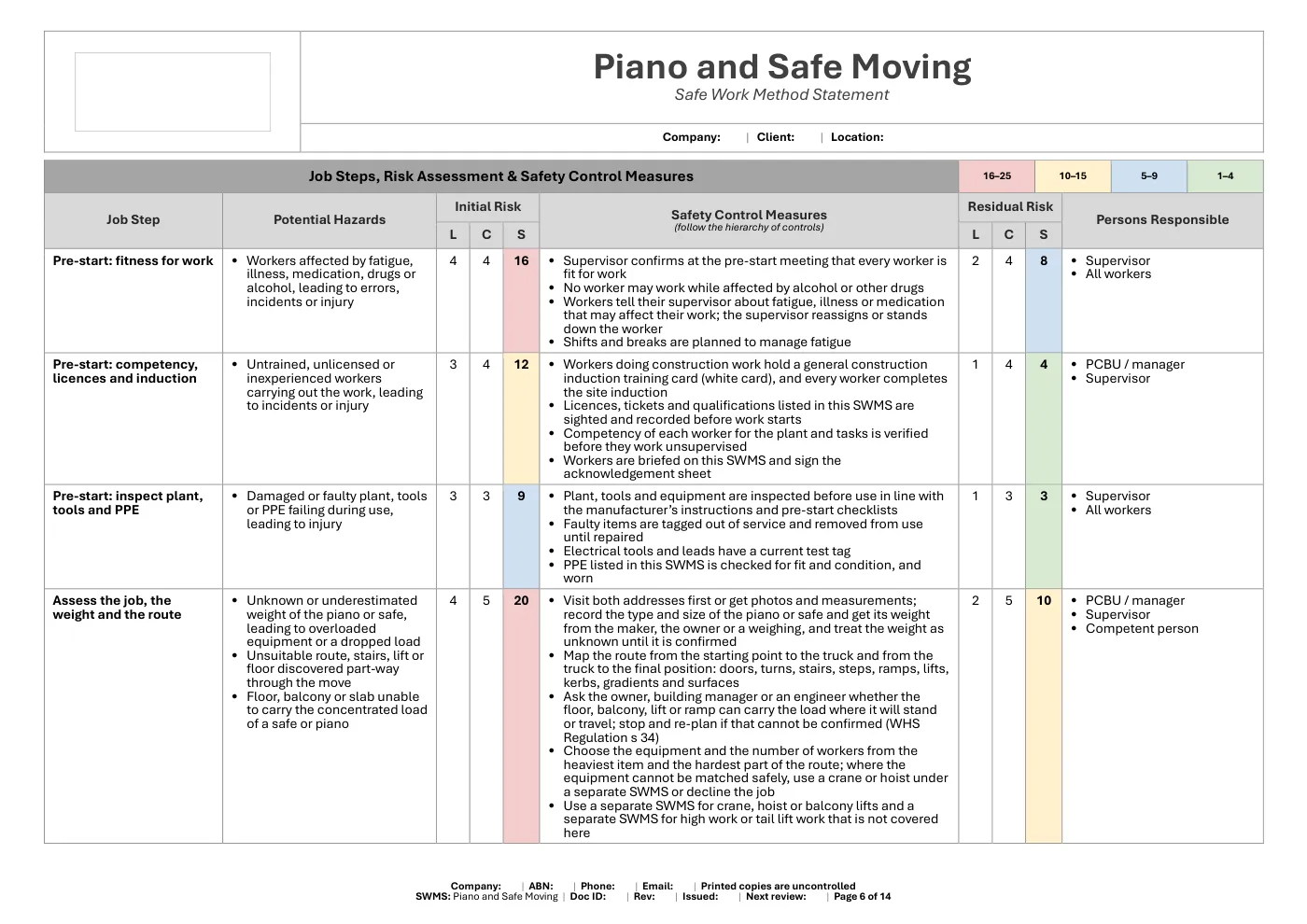
The job steps run in the order the work is done, from pre-start checks to finishing up. The hazards and controls include:
- Pianos and safes toppling or dropping
- Crush injuries to hands and feet
- Runaway loads on dollies and trolleys
- Loads sliding on stairs
- Floors and balconies failing under heavy loads
- Strains from very heavy, awkward items
- Tail lift and ramp loading
- Load shift on the truck
- Unknown or underestimated weights
- Protecting floors, walls and doorways
- Slips, trips and falls on stairs
- Fatigue and heat on long moves
High Risk Construction Work
No high risk construction work items (WHS Regulation 2011 (Qld) s 291) are pre-ticked, because this work is not high risk construction work by itself. Tick the items that apply to your job, such as a fall risk of more than 2 metres or work where powered mobile plant is moving.
Licences, Training and Competency
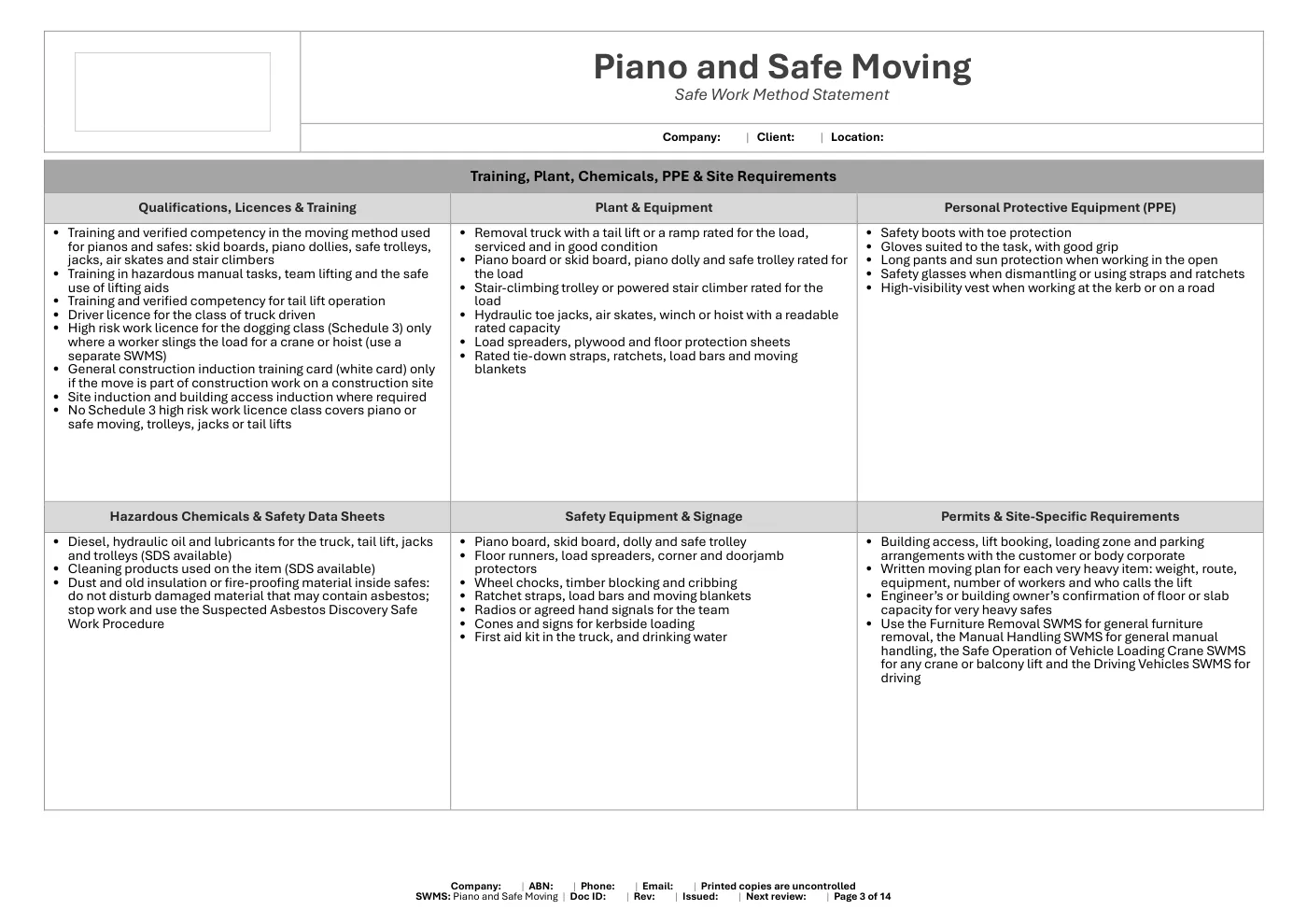
- Training and verified competency in the moving method used for pianos and safes: skid boards, piano dollies, safe trolleys, jacks, air skates and stair climbers
- Training in hazardous manual tasks, team lifting and the safe use of lifting aids
- Training and verified competency for tail lift operation
- Driver licence for the class of truck driven
- High risk work licence for the dogging class (Schedule 3) only where a worker slings the load for a crane or hoist (use a separate SWMS)
- General construction induction training card (white card) only if the move is part of construction work on a construction site
- Site induction and building access induction where required
- No Schedule 3 high risk work licence class covers piano or safe moving, trolleys, jacks or tail lifts
Legislation and Codes of Practice Referenced
- Work Health and Safety Act 2011 (Qld)
- Work Health and Safety Regulation 2011 (Qld)
- WHS Regulation 2011 (Qld) ss 205 to 213: plant (proper use s 206, operational controls s 210, maintenance and inspection s 213)
- WHS Regulation 2011 (Qld) ss 34 to 36: identifying hazards, managing risk and the hierarchy of control measures
- WHS Regulation 2011 (Qld) s 60: managing risks of hazardous manual tasks
- WHS Regulation 2011 (Qld) s 78: managing the risk of a fall
- WHS Regulation 2011 (Qld) ss 42 and 44: first aid and personal protective equipment
- Hazardous Manual Tasks Code of Practice 2021
- Managing Risks of Plant in the Workplace Code of Practice 2021
- Managing the Risk of Falls at Workplaces Code of Practice 2021
- Managing the Work Environment and Facilities Code of Practice 2021
- First Aid in the Workplace Code of Practice 2021
- How to Manage Work Health and Safety Risks Code of Practice 2021
- Heavy Vehicle National Law (Queensland), applied by the Heavy Vehicle National Law Act 2012 (Qld): s 6 (heavy vehicle means a vehicle with a GVM or ATM of more than 4.5 t), s 26C (primary duty of each party in the chain of responsibility), s 96 (compliance with mass requirements), s 110 (national regulations may prescribe loading requirements), s 111 (compliance with the loading requirements) and s 228 (duty of driver to avoid driving while fatigued or unfit to drive)
- National Load Restraint Guide (guidance only, not law)
What You Get
- An editable Microsoft Word document (14 pages), laid out on A4 landscape pages
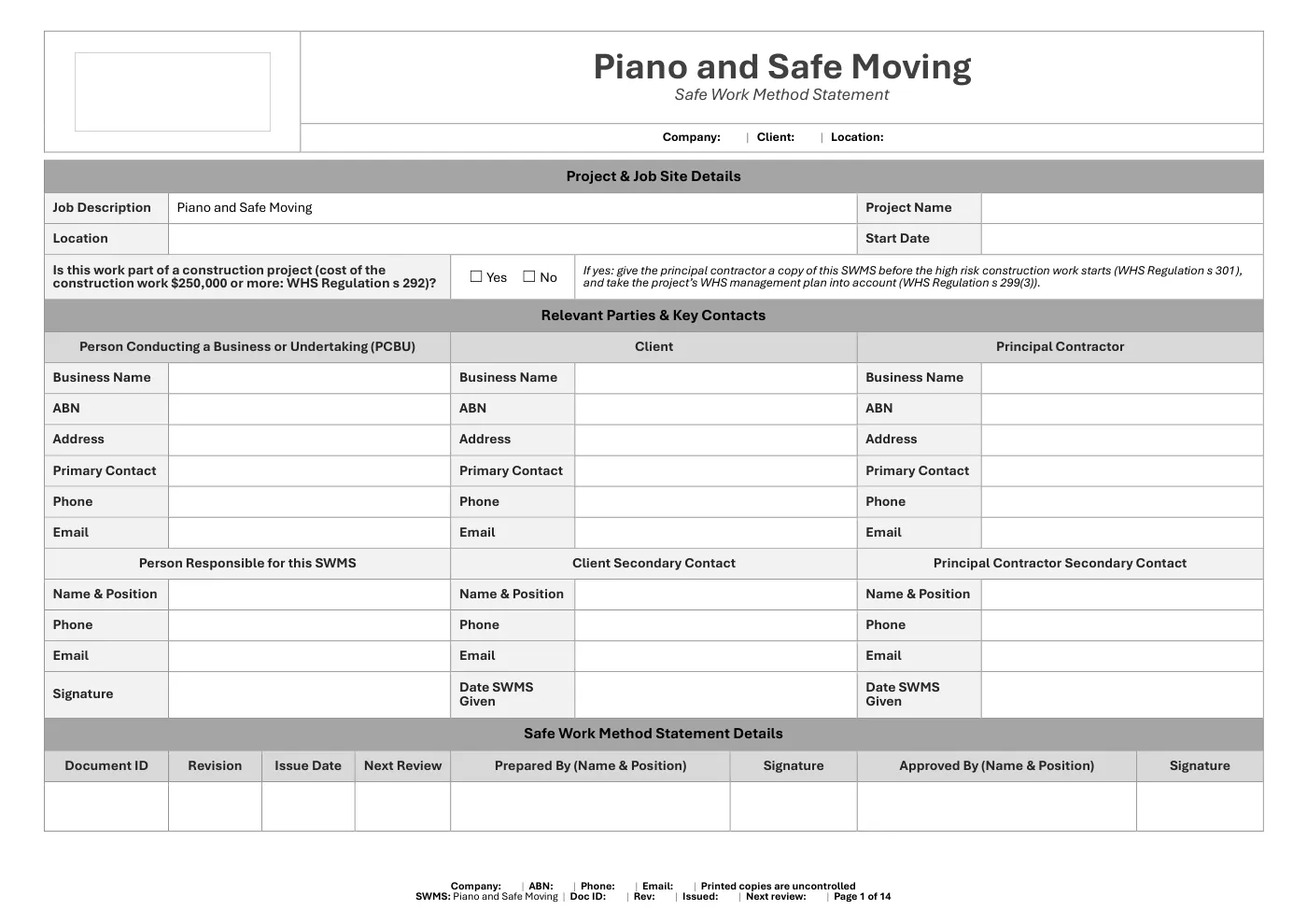
- Business, client, job and document details typed once and filled in on every page, plus a space for your logo
- The high risk construction work checklist, worded as WHS Regulation s 291, and the construction project question (s 292)
- A worker and health and safety representative consultation record
- Qualifications, plant, PPE, hazardous chemicals, safety equipment, permits, references and emergency arrangements filled in for this work
- A 5 x 5 risk matrix, and job steps with initial and residual risk scores and the people responsible
- Implementing, monitoring and review requirements, an additional controls log, revision history and a worker sign-on sheet
Review and adjust it for your site, your plant and the way your crew does the job, and talk it through with your workers before work starts. If you have any trouble downloading this SWMS, you can contact us at any time. Please make sure you read our Disclaimer before downloading this SWMS.
Having trouble with your download? Contact us any time. Please read our Disclaimer before downloading.
How to use it
From download to site in three steps
Buy and download
Check out with card, Apple Pay or Google Pay. Your download buttons appear straight away and the links are emailed to you. Links work for 3 months, so save your copies.
Make it yours
Open it in Microsoft Word or Excel. Add your logo, business details, site and job information, and adjust it to how the work is done.
Brief your crew
Talk it through with the workers doing the job, have them sign on, and keep it on site. Review it whenever the job or conditions change.
What format is it?
Microsoft Word. Edit it in Word, or free in Word for the web, and add your own logo and business details.
How do I get it after I pay?
Your download buttons appear as soon as checkout finishes, and the links are emailed to you. You can re-download from your account at any time.
Is it compliant with Queensland law?
It's written around Queensland's Work Health and Safety Act 2011 and Regulation 2011. Tailor it to your site, consult your workers and review it whenever conditions change; no template can guarantee compliance on its own.
What if it isn't right for my job?
If it doesn't match its description or has a fault, tell us and we'll fix it. If you're still not happy, we'll refund you or give you store credit, your choice. Check the sample pages first, as we don't refund a change of mind.
More templates like this
$49.99

Water Blaster SWMS
$39.99


Reviews