Mustering by Motorbike and Side-by-Side SWMS
Editable Word SWMS template for mustering stock on motorbikes and side-by-sides in Queensland: rollover, collision, rough terrain, stock behaviour and remote travel.
RG
Written by Ryan Graham, health and safety professional (16 years on Queensland sites)
$39.99 incl. GST
AUD · one-off purchase · instant download
- Instant download · your links arrive by email straight after checkout and work for 3 months, so save your copy
- Make it yours in minutes · edit in Microsoft Word and add your logo
- Quality guarantee · we'll fix any problem, then refund you or give store credit if you're still not happy
- Secure checkout · card, Apple Pay or Google Pay through Stripe
Save with a bundle
About this template
Suits cattle and sheep properties, station hands and stock contractors who muster on farm motorbikes and side-by-side vehicles. It follows the muster in order: planning and vehicle choice, rider and driver checks, pre-start checks, travel, riding and driving rough country, working the mob, gates and power lines, heat and fatigue, emergencies and finishing at the yards. Quad bikes and horses need separate SWMS.
Mustering is not high risk construction work, so no item is pre-ticked and a SWMS is required by law only for high risk construction work (WHS Regulation s 299). The document works as a written safe work procedure and task risk assessment that you tailor to your property, vehicles and crew. If any part of the work is construction work, tick the reg 291 items that apply.
Learn More: What Is A Safe Work Method Statement?
Have you ever been asked to provide a SWMS on a project in Queensland? Read our guide to what a Safe Work Method Statement is and when you need one.
What Is Covered In Our Mustering by Motorbike and Side-by-Side SWMS?
The job steps run in the order the work is done, from pre-start checks to finishing up. The hazards and controls include:
- Motorbike crash on rough or steep ground
- Side-by-side rollover and ejection
- Head injury without a helmet
- Collision with stock, trees and fences
- Stock rushing, charging or turning on riders
- Dust reducing visibility
- Gates, wire fences and creek crossings
- Overhead power lines
- Heat, fatigue and dehydration
- Remote travel and no phone coverage
- Breakdown, injury and recovery
- Zoonoses and animal contact
High Risk Construction Work
No high risk construction work items (WHS Regulation 2011 (Qld) s 291) are pre-ticked, because this work is not high risk construction work by itself. Tick the items that apply to your job, such as a fall risk of more than 2 metres or work where powered mobile plant is moving.
Licences, Training and Competency
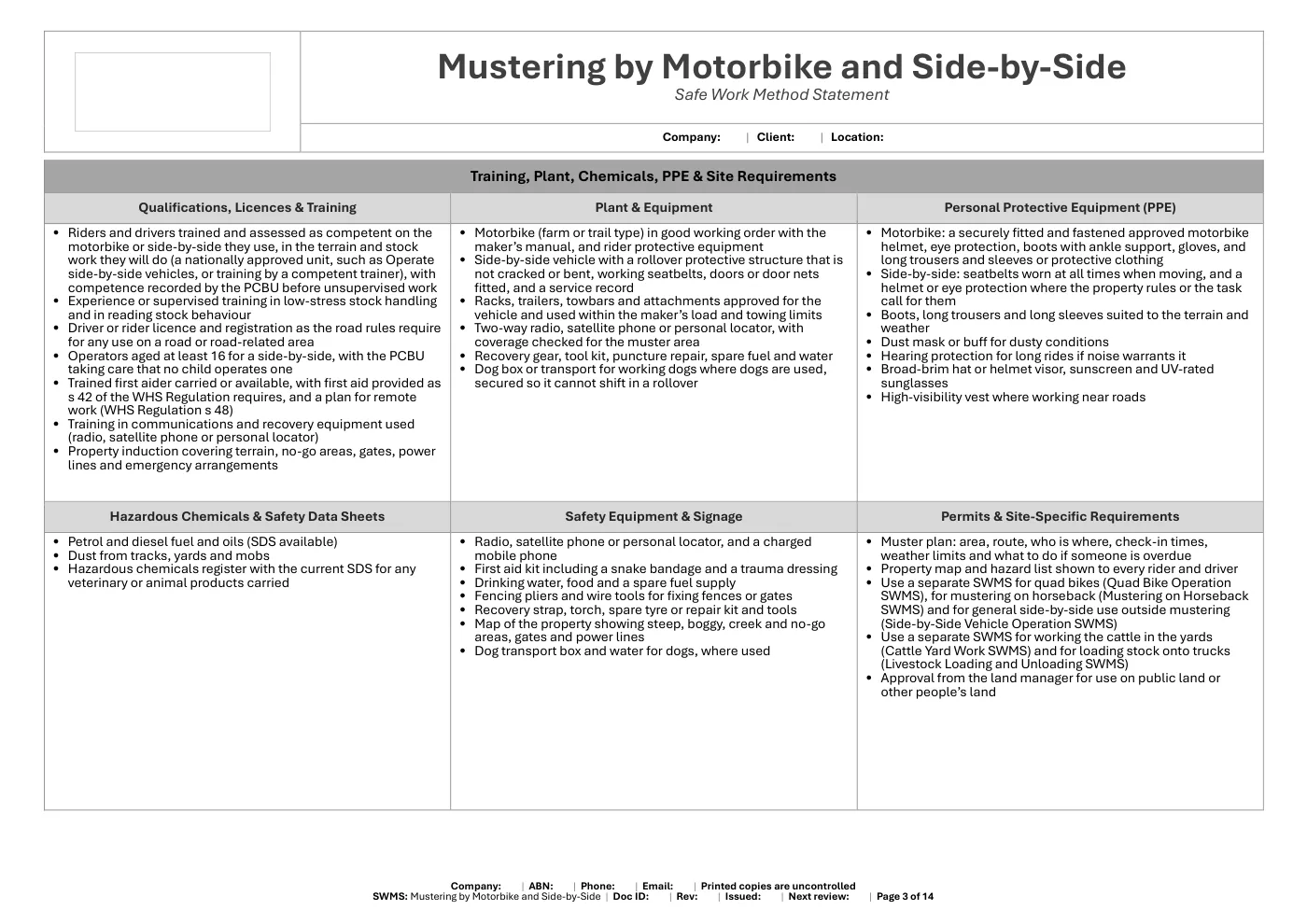
- Riders and drivers trained and assessed as competent on the motorbike or side-by-side they use, in the terrain and stock work they will do (a nationally approved unit, such as Operate side-by-side vehicles, or training by a competent trainer), with competence recorded by the PCBU before unsupervised work
- Experience or supervised training in low-stress stock handling and in reading stock behaviour
- Driver or rider licence and registration as the road rules require for any use on a road or road-related area
- Operators aged at least 16 for a side-by-side, with the PCBU taking care that no child operates one
- Trained first aider carried or available, with first aid provided as s 42 of the WHS Regulation requires, and a plan for remote work (WHS Regulation s 48)
- Training in communications and recovery equipment used (radio, satellite phone or personal locator)
- Property induction covering terrain, no-go areas, gates, power lines and emergency arrangements
Legislation and Codes of Practice Referenced
- Work Health and Safety Act 2011 (Qld)
- Work Health and Safety Regulation 2011 (Qld)
- WHS Regulation 2011 (Qld) ss 214 and 215: powered mobile plant (overturning, ejection and collision; operator protective devices; no riders without equivalent protection)
- WHS Regulation 2011 (Qld) s 48: remote or isolated work, with a system of work that includes effective communication
- WHS Regulation 2011 (Qld) s 42: first aid
- WHS Regulation 2011 (Qld) s 60: managing risks of hazardous manual tasks
- WHS Regulation 2011 (Qld) ss 56 and 57: noise exposure standard and managing the risk of hearing loss
- WHS Act 2011 (Qld) ss 36 and 38 and WHS Regulation 2011 (Qld) s 699: notifying a serious illness, such as Q fever or leptospirosis, contracted through contact with animals
- Rural Plant Code of Practice 2024 (side-by-side vehicles in s 7.5 and Appendix 7, and rural plant risks generally)
- Managing Risks of Plant in the Workplace Code of Practice 2021
- Hazardous Manual Tasks Code of Practice 2021
- Managing Noise and Preventing Hearing Loss at Work Code of Practice 2021
- First Aid in the Workplace Code of Practice 2021
- Managing the Work Environment and Facilities Code of Practice 2021
- Children and Young Workers Code of Practice 2006
- How to Manage Work Health and Safety Risks Code of Practice 2021
- Electrical Safety Act 2002 (Qld)
- Electrical Safety Regulation 2026 (Qld): overhead power line exclusion zones (sections 10 to 13 and schedule 2)
- Safe Work Australia model Code of Practice: Managing the risk of fatigue at work (model code, not approved in Queensland; guidance only)
What You Get
- An editable Microsoft Word document (14 pages), laid out on A4 landscape pages
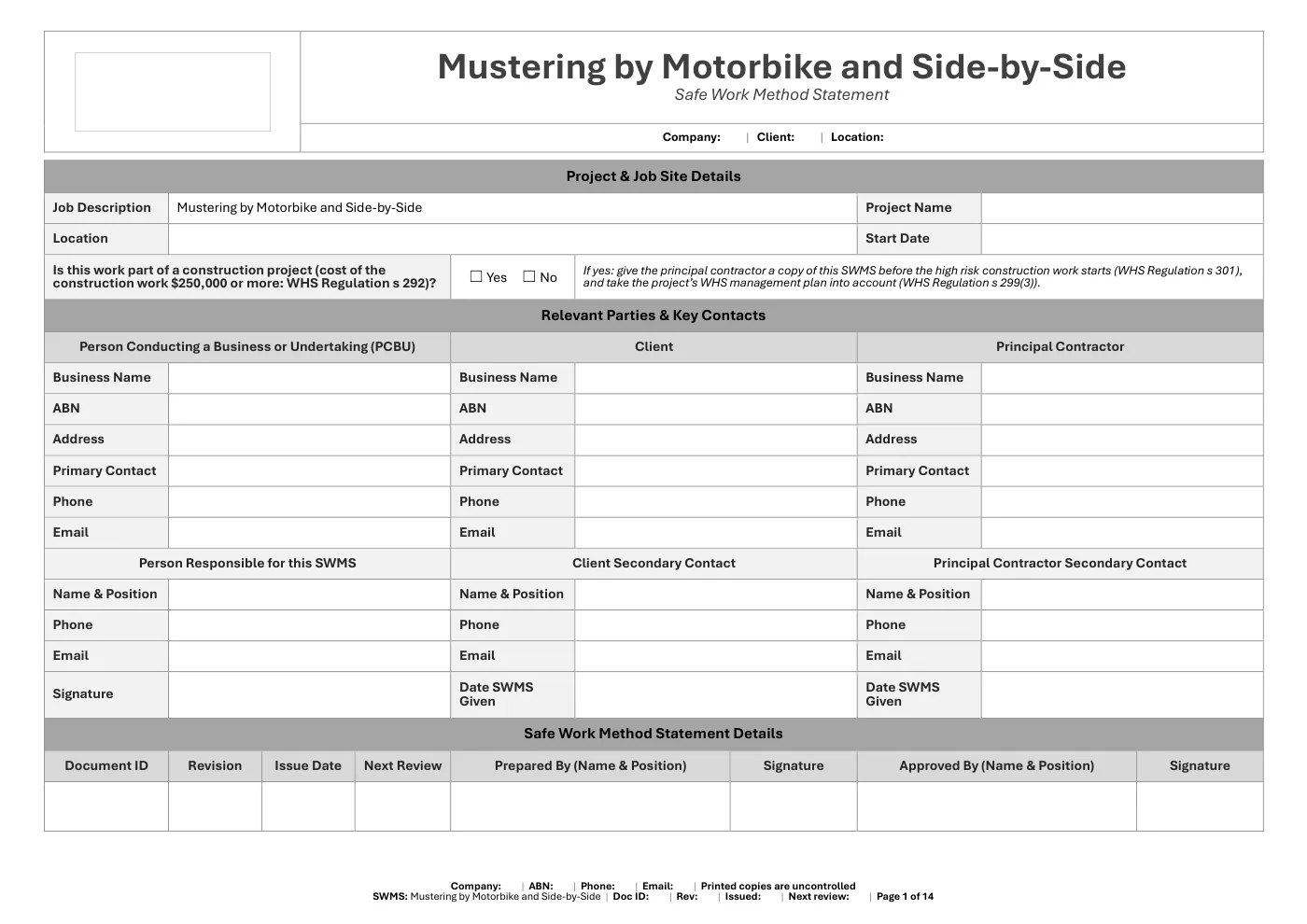
- Business, client, job and document details typed once and filled in on every page, plus a space for your logo
- The high risk construction work checklist, worded as WHS Regulation s 291, and the construction project question (s 292)
- A worker and health and safety representative consultation record
- Qualifications, plant, PPE, hazardous chemicals, safety equipment, permits, references and emergency arrangements filled in for this work
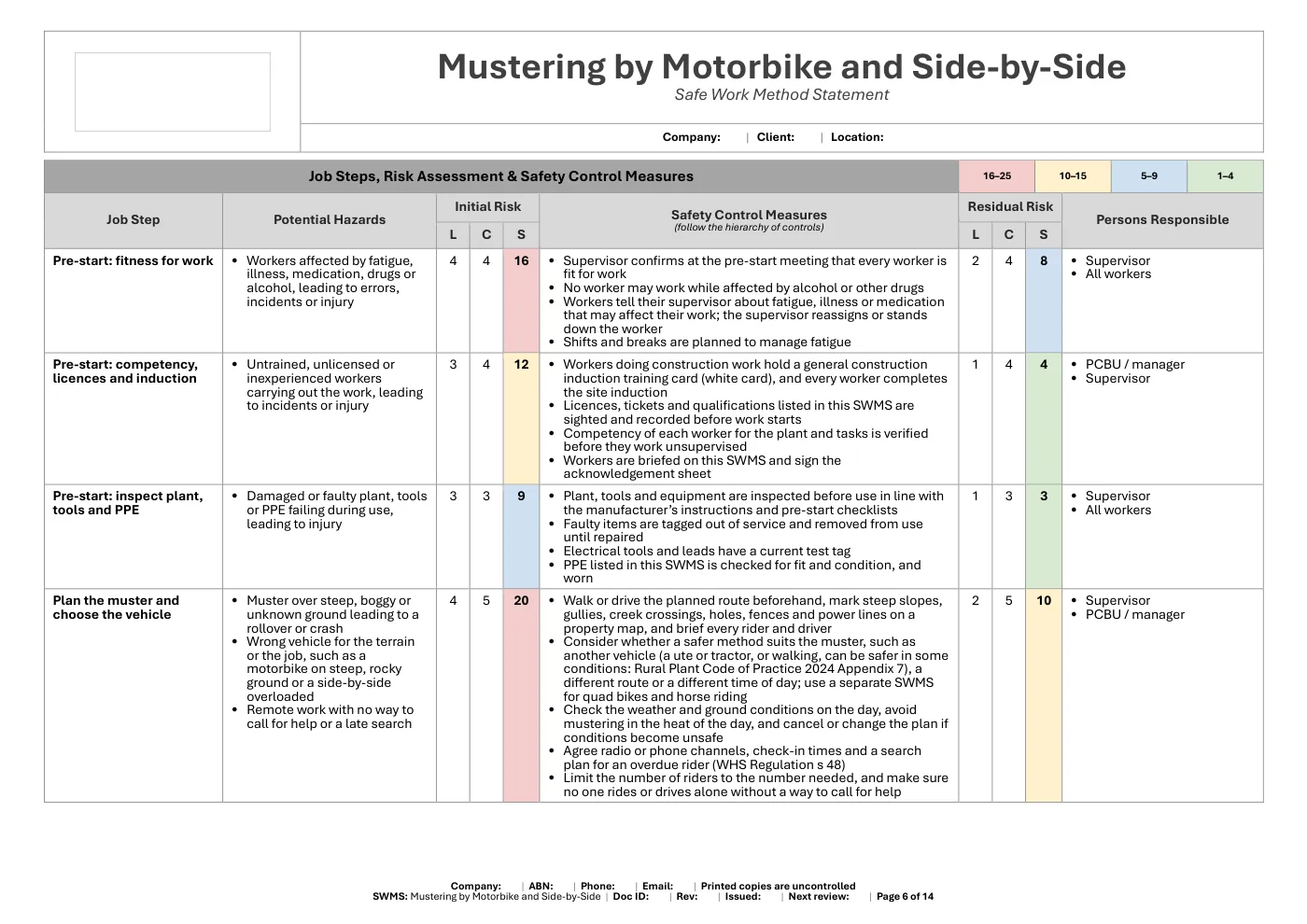
- A 5 x 5 risk matrix, and job steps with initial and residual risk scores and the people responsible
- Implementing, monitoring and review requirements, an additional controls log, revision history and a worker sign-on sheet
Review and adjust it for your site, your plant and the way your crew does the job, and talk it through with your workers before work starts. If you have any trouble downloading this SWMS, you can contact us at any time. Please make sure you read our Disclaimer before downloading this SWMS.
Having trouble with your download? Contact us any time. Please read our Disclaimer before downloading.
How to use it
From download to site in three steps
Buy and download
Check out with card, Apple Pay or Google Pay. Your download buttons appear straight away and the links are emailed to you. Links work for 3 months, so save your copies.
Make it yours
Open it in Microsoft Word or Excel. Add your logo, business details, site and job information, and adjust it to how the work is done.
Brief your crew
Talk it through with the workers doing the job, have them sign on, and keep it on site. Review it whenever the job or conditions change.
What format is it?
Microsoft Word. Edit it in Word, or free in Word for the web, and add your own logo and business details.
How do I get it after I pay?
Your download buttons appear as soon as checkout finishes, and the links are emailed to you. You can re-download from your account at any time.
Is it compliant with Queensland law?
It's written around Queensland's Work Health and Safety Act 2011 and Regulation 2011. Tailor it to your site, consult your workers and review it whenever conditions change; no template can guarantee compliance on its own.
What if it isn't right for my job?
If it doesn't match its description or has a fault, tell us and we'll fix it. If you're still not happy, we'll refund you or give you store credit, your choice. Check the sample pages first, as we don't refund a change of mind.
More templates like this
$39.99

Excavator SWMS
$49.99


Reviews