Modular Home Crane Lift and Placement SWMS
Lifting and placing modular homes by crane in Queensland: lift planning, rigging, ground bearing, power lines and exclusion zones. An editable Word SWMS template.
RG
Written by Ryan Graham, health and safety professional (16 years on Queensland sites)
$49.99 incl. GST
AUD · one-off purchase · instant download
- Instant download · your links arrive by email straight after checkout and work for 3 months, so save your copy
- Make it yours in minutes · edit in Microsoft Word and add your logo
- Quality guarantee · we'll fix any problem, then refund you or give store credit if you're still not happy
- Secure checkout · card, Apple Pay or Google Pay through Stripe
Save with a bundle
About this template
Suits builders, modular home installers, crane companies and riggers who lift prefabricated homes and modules from a delivery truck onto foundations. It covers the lift plan, site and ground checks, power lines, exclusion zones and communications, crane set-up, rigging, the lift itself, setting the module and releasing the rigging at height, and packing up.
Placing a module by crane is construction work, and a SWMS is required for high risk construction work (WHS Regulation s 299). Movement of powered mobile plant (the crane and truck) is ticked. Also tick the items that apply to your job: a fall of more than 2 metres when upper modules are placed or unhooked, work on or near energised electrical installations or services such as overhead lines, and a road in use by traffic.
New to SWMS? Read What Is A Safe Work Method Statement?
What Is Covered In Our Modular Home Crane Lift and Placement SWMS?
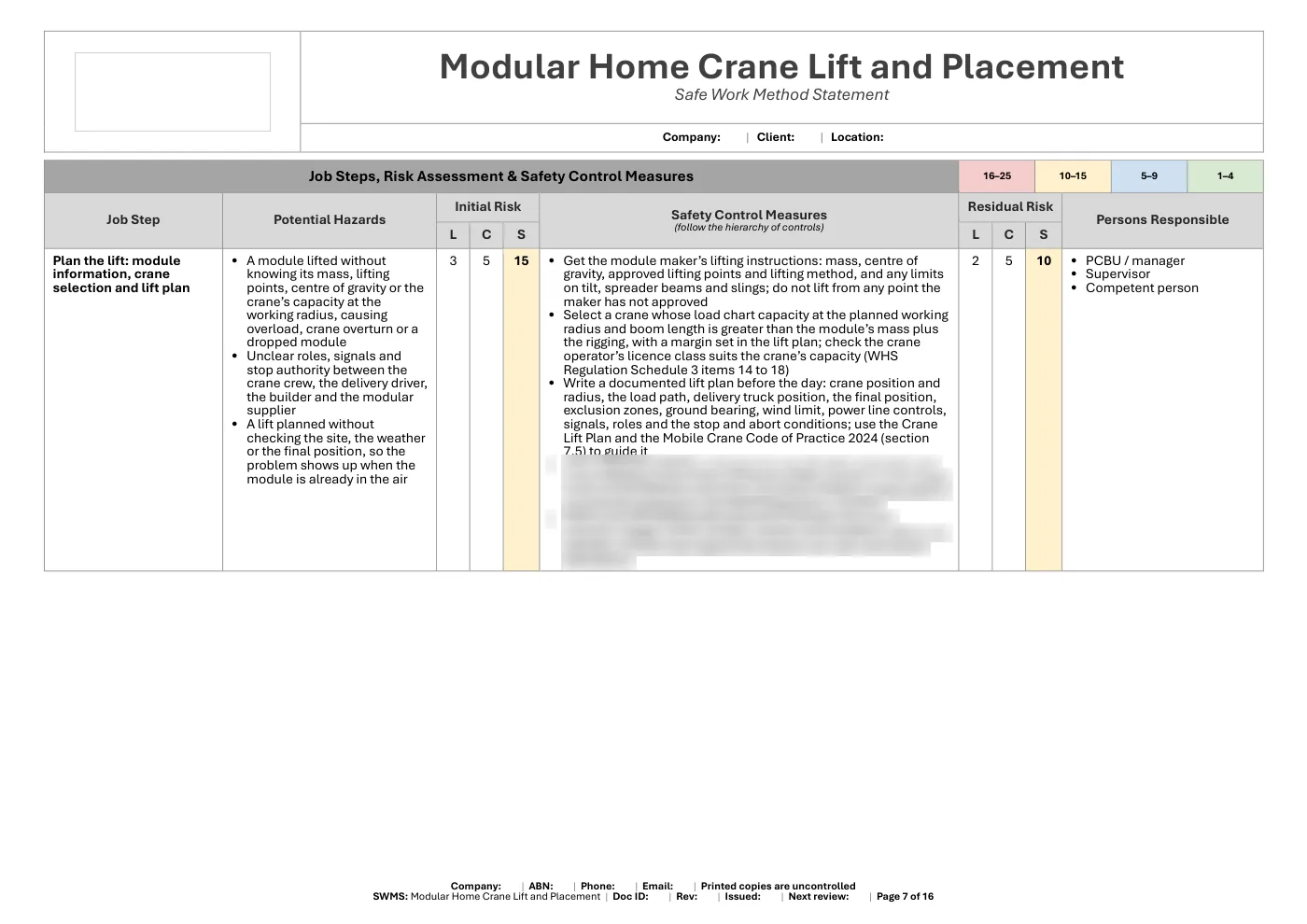
After the standard pre-start checks, the job steps run from “Plan the lift: module information, crane selection and lift plan” to “Stow the crane, recover the rigging and clear the site”. The hazards and controls include:
- Crane overturning on soft or sloping ground
- Overload and wrong lifting points on the module
- Contact with overhead power lines
- Wind loading on the large module surface
- Rigging failure and dropped modules
- People under or near the suspended load
- Release of transport restraints on the trailer
- Crush injuries when landing the module
- Falls when unhooking at height
- Traffic and public near the lift zone
- Pinch points between modules
- Poor communication between crane, dogger and driver
High Risk Construction Work
These high risk construction work items (WHS Regulation 2011 (Qld) s 291) are already ticked because they are part of this work. Tick any others that apply to your job:
- Is carried out in an area at a workplace in which there is any movement of powered mobile plant
Licences, Training and Competency
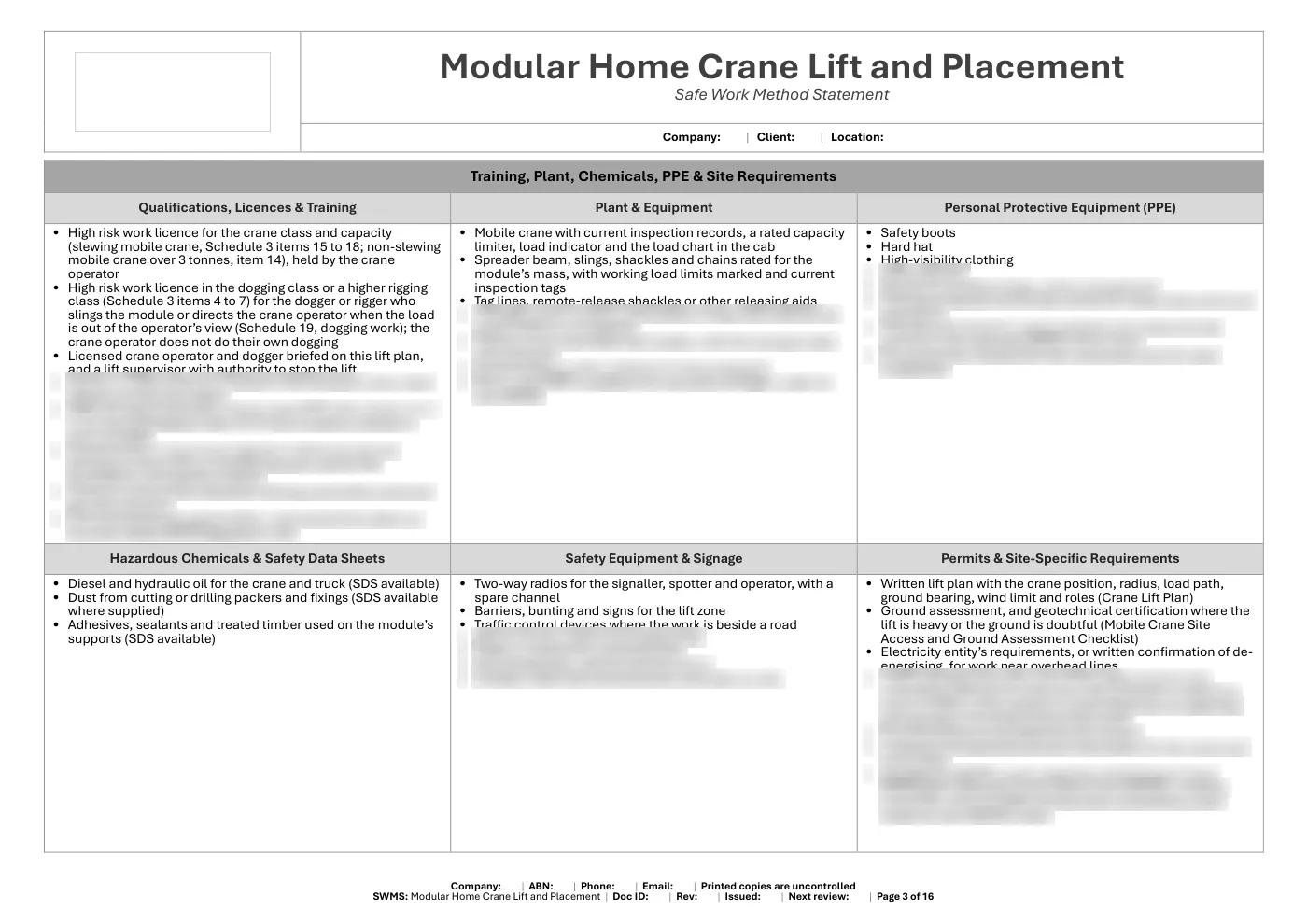
- High risk work licence for the crane class and capacity (slewing mobile crane, Schedule 3 items 15 to 18; non-slewing mobile crane over 3 tonnes, item 14), held by the crane operator
- High risk work licence in the dogging class or a higher rigging class (Schedule 3 items 4 to 7) for the dogger or rigger who slings the module or directs the crane operator when the load is out of the operator’s view (Schedule 19, dogging work); the crane operator does not do their own dogging
- Licensed crane operator and dogger briefed on this lift plan, and a lift supervisor with authority to stop the lift
- Spotter or safety observer trained in the exclusion zone, hand signals and the stop signal
- High risk work licence for a boom-type EWP with a boom of 11 m or more (Schedule 3 item 21) if one is used to unhook or work at height
- Geotechnical or structural engineer’s advice for ground bearing on heavy lifts or doubtful ground, and for the foundations carrying the module
- General construction induction training card (white card) and the site induction
- First aid equipment and facilities, and trained first aiders as the work needs (WHS Regulation s 42)
Legislation and Codes of Practice Referenced
- Work Health and Safety Act 2011 (Qld)
- Work Health and Safety Regulation 2011 (Qld)
- Work Health and Safety Regulation 2011 (Qld): ss 214, 215 and 219 (powered mobile plant, plant that lifts or suspends loads)
- Work Health and Safety Regulation 2011 (Qld): s 298 (security of a workplace) and ss 315L and 315M (loads lifted over an adjoining area, and closing it; s 315L does not apply to housing construction work)
- Work Health and Safety Regulation 2011 (Qld): ss 306C and 306D (falls in construction work: 3 m for housing construction work, 2 m for other construction work)
- Mobile Crane Code of Practice 2024
- Managing Risks of Plant in the Workplace Code of Practice 2021
- Managing the Risk of Falls at Workplaces Code of Practice 2021
- Hazardous Manual Tasks Code of Practice 2021
- Traffic Management for Construction or Maintenance Work Code of Practice 2008 (when the lift is on or beside a road)
- Managing the Work Environment and Facilities Code of Practice 2021
- First Aid in the Workplace Code of Practice 2021
- How to Manage Work Health and Safety Risks Code of Practice 2021
- Electrical Safety Regulation 2026 (Qld): ss 10, 11 and 13 and Schedule 2 (overhead line exclusion zones)
- Electrical Safety Act 2002 (Qld) and Electrical Safety Code of Practice 2020 – Working near overhead and underground electric lines (distances come from the 2026 Regulation)
- WorkSafe Queensland guide: Working safely in the house relocation industry (guidance, not law)
What You Get
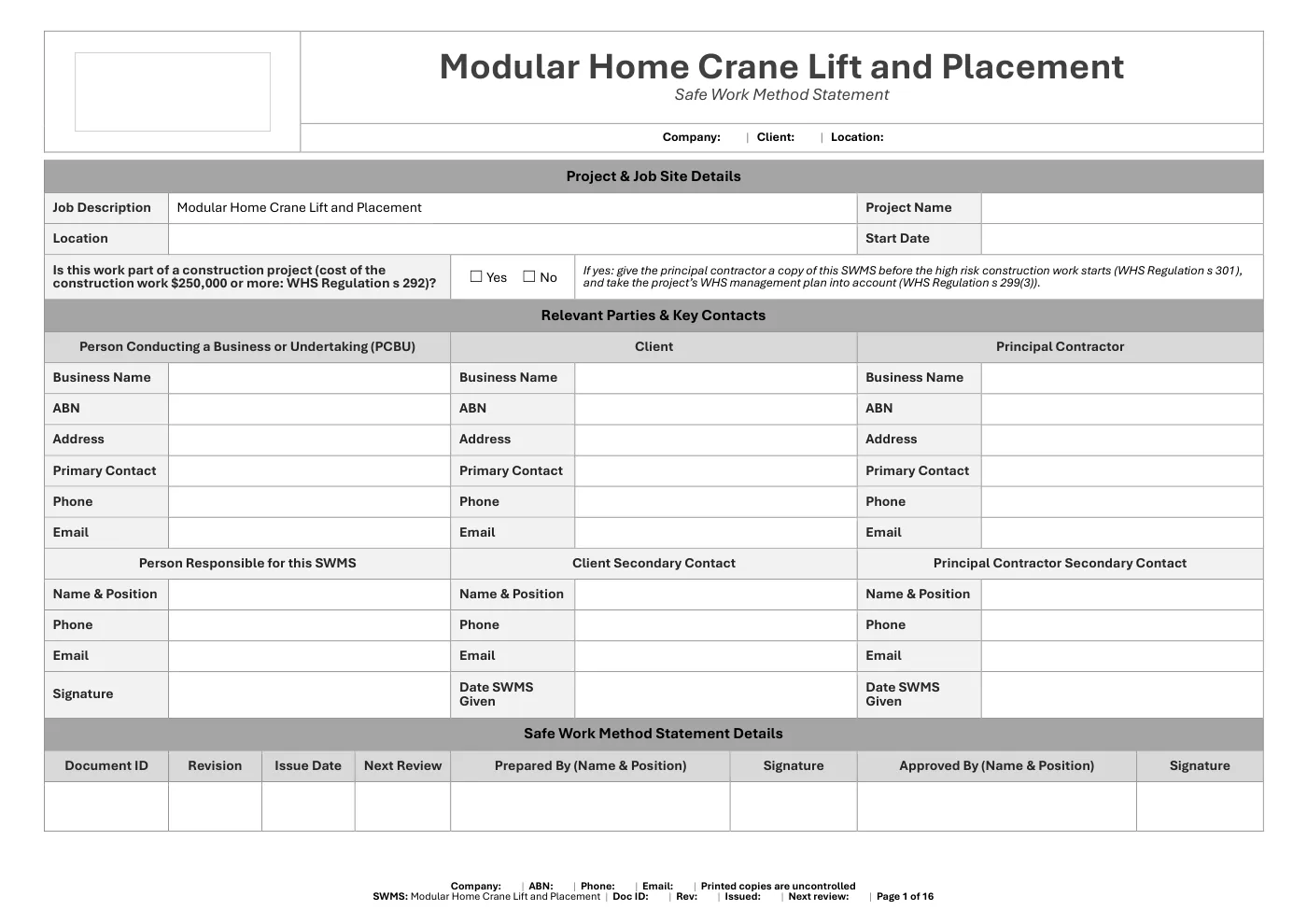
- An editable Microsoft Word document (16 A4 landscape pages). Type your business, client and job details once and they fill in on every page, with a space for your logo
- 9 job steps for this work, each with its hazards, controls, initial and residual risk scores and the person responsible
- PPE listed for this job: safety boots; hard hat; high-visibility clothing; safety glasses
- Emergency arrangements for: crane overturning or load drop, contact with a power line and person trapped or struck by the module or rigging
- Plus the parts every Work Safety QLD SWMS shares, from the s 291 checklist to the worker sign-on sheet (see the layout in our free SWMS template)
Adjust it for your site, plant and crew, and talk it through with your workers before work starts. Please make sure you read our Disclaimer before downloading this SWMS.
Checked against the Queensland laws and codes of practice listed above. Last reviewed November 2026.
Having trouble with your download? Contact us any time. Please read our Disclaimer before downloading.
How to use it
From download to site in three steps
Buy and download
Check out with card, Apple Pay or Google Pay. Your download buttons appear straight away and the links are emailed to you. Links work for 3 months, so save your copies.
Make it yours
Open it in Microsoft Word or Excel. Add your logo, business details, site and job information, and adjust it to how the work is done.
Brief your crew
Talk it through with the workers doing the job, have them sign on, and keep it on site. Review it whenever the job or conditions change.
What format is it?
Microsoft Word. Edit it in Word, or free in Word for the web, and add your own logo and business details.
How do I get it after I pay?
Your download buttons appear as soon as checkout finishes, and the links are emailed to you. You can re-download from your account at any time.
Is it compliant with Queensland law?
It's written around Queensland's Work Health and Safety Act 2011 and Regulation 2011. Tailor it to your site, consult your workers and review it whenever conditions change; no template can guarantee compliance on its own.
What if it isn't right for my job?
If it doesn't match its description or has a fault, tell us and we'll fix it. If you're still not happy, we'll refund you or give you store credit, your choice. Check the sample pages first, as we don't refund a change of mind.
More templates like this
$49.99
Hot Work SWMS
$39.99
Concreting SWMS
$59.99


Reviews